
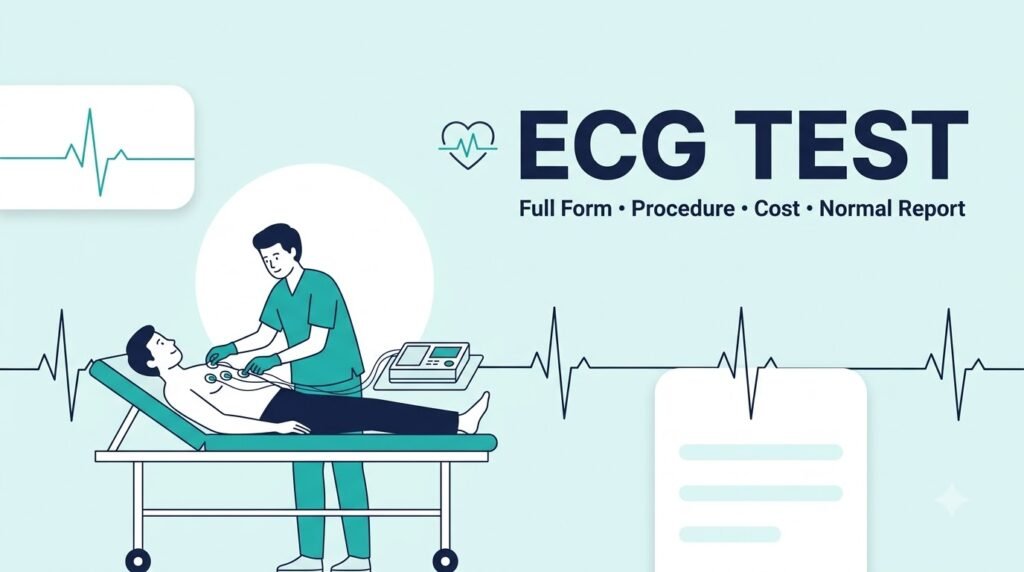
An ECG test, also called an electrocardiogram or EKG, is a quick and generally painless test that records the electrical activity of the heart.
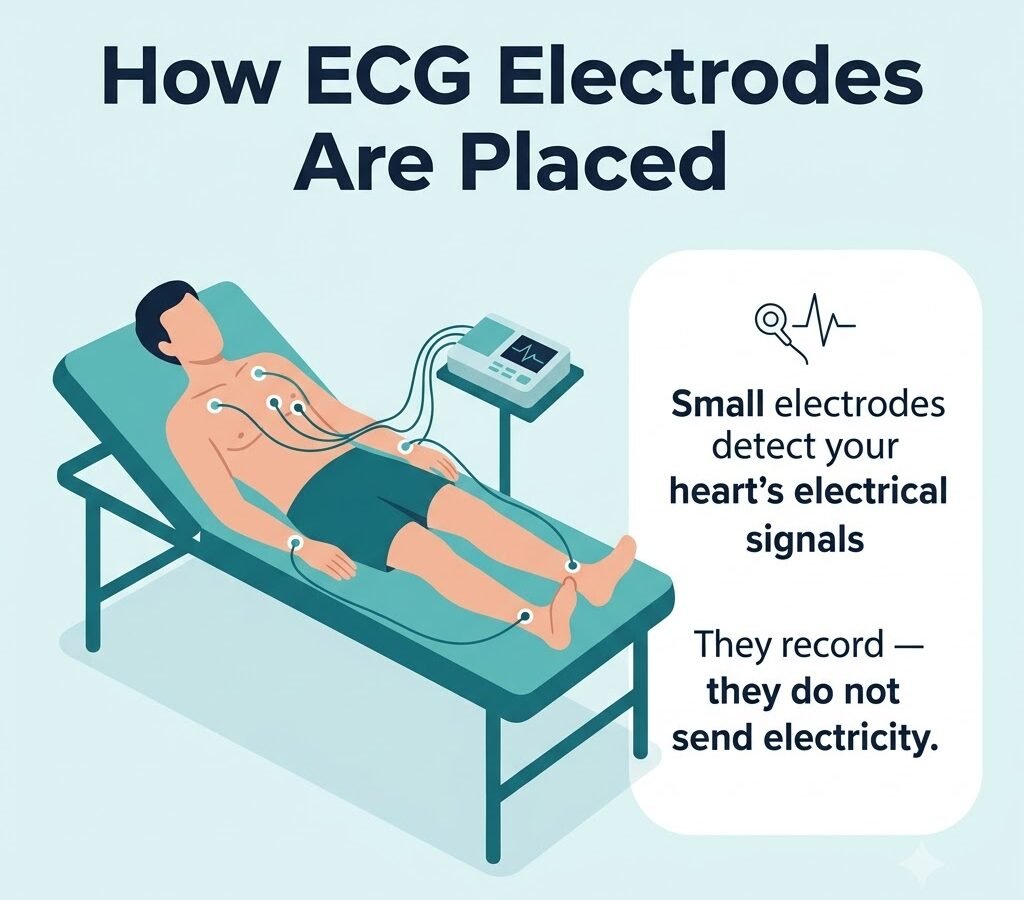
It can help healthcare professionals assess the heart’s rate, rhythm and electrical activity and look for certain changes associated with heart conditions. An ECG does not send electricity into your body. Small electrodes placed on the skin detect the electrical signals naturally produced by your heart.
In this guide, we explain the ECG full form, why an ECG is done, how the test is performed, preparation, ECG test cost in India, what a normal ECG report may show, what an abnormal ECG can mean, and when additional testing may be needed.
Important: An ECG is an important diagnostic test, but an ECG result should be interpreted together with your symptoms, medical history, examination and other tests when required.
ECG Test Quick Facts
| Information | Details |
|---|---|
| Full form | Electrocardiogram |
| Also called | EKG |
| What it records | Electrical activity of the heart |
| Test duration | Usually a few minutes for the recording |
| Pain | Usually painless |
| Fasting | Usually not required for a standard resting ECG |
| Electricity sent into body | No |
| Common uses | Heart rate, rhythm and electrical abnormalities |
| ECG cost | Varies by location, provider and type of ECG |
What Is an ECG Test?
An electrocardiogram (ECG) records the electrical signals produced by the heart as it beats.
Each heartbeat is controlled by electrical activity that helps coordinate the contraction of the heart. Electrodes placed on the skin detect this activity and the ECG machine converts the signals into a waveform or tracing.
An ECG can provide information about:
- How fast the heart is beating
- Whether the heartbeat is regular or irregular
- The timing and strength of electrical signals
- Certain electrical conduction abnormalities
- Some changes associated with heart injury or disease
The American Heart Association notes that an ECG can help evaluate conditions including arrhythmias and heart attack.
What Is the ECG Full Form?
The ECG full form is electrocardiogram.
The word can be understood as:
- Electro – electrical activity
- Cardio – heart
- Gram – recording
You may also see EKG instead of ECG. ECG and EKG refer to the same test. EKG comes from the German spelling of electrocardiogram.
Why Is an ECG Test Done?
A doctor or healthcare professional may recommend an ECG when there are symptoms or other reasons to evaluate the heart.
Common reasons include:
- Chest discomfort or chest pain
- Palpitations
- Dizziness
- Fainting
- Shortness of breath
- Fast or slow heartbeat
- Irregular heartbeat
- Monitoring a known heart condition
- Before certain procedures or surgery
- Monitoring some medicines or cardiac treatments
An ECG may help evaluate conditions such as:
- Arrhythmias
- Atrial fibrillation
- Bradycardia
- Tachycardia
- Electrical conduction abnormalities
- Some changes associated with heart attack
However, an ECG does not diagnose every heart condition by itself. The result needs to be interpreted together with symptoms, medical history and other clinical information.
How Is a Resting ECG Test Performed?
A standard resting ECG is usually straightforward.
1. You lie down
You will normally lie on an examination table and remain still during the recording.
2. Electrodes are placed
Small adhesive electrodes are placed on the chest and limbs.
3. Electrodes are connected
The electrodes are connected by wires to an ECG machine.
4. The electrical activity is recorded
You will be asked to remain still while the machine records your heart’s electrical signals.
5. The electrodes are removed
The electrodes are removed after the recording is complete.
The actual recording usually takes only a few minutes, although the complete appointment may take longer because of preparation and electrode placement.
Is an ECG Test Painful?
Usually, no.
A standard ECG is generally painless. The machine only records electrical activity produced by your heart and does not send electricity into your body.
Some people may experience minor discomfort when adhesive electrodes are removed. Temporary skin irritation can also occur in some people.
Do You Need to Fast Before an ECG?
A standard resting ECG usually does not require fasting.
For a routine ECG:
- Wear clothing that allows easy access to the chest.
- Avoid heavy creams, oils or lotions where electrodes may be placed.
- Tell the healthcare professional about medicines you take.
- Follow any separate preparation instructions if you are having an exercise ECG or another test.
Preparation can be different for an exercise or stress ECG.
How Long Does an ECG Test Take?
The actual ECG recording usually takes only a few minutes.
The total appointment may take longer because the healthcare professional needs to prepare the skin, place the electrodes and obtain a good-quality recording.
What Does an ECG Report Show?
An ECG report may contain several measurements and observations.
The exact format varies between ECG machines and healthcare providers.
Heart Rate
The report may show your heart rate in beats per minute.
A commonly used resting adult reference range is around 60–100 beats per minute, although the appropriate heart rate can vary depending on the individual and clinical situation.
A heart rate outside this range does not automatically mean that a person has heart disease.
Heart Rhythm
The report may describe whether the heartbeat appears regular or irregular.
It may also mention sinus rhythm, depending on the ECG findings.
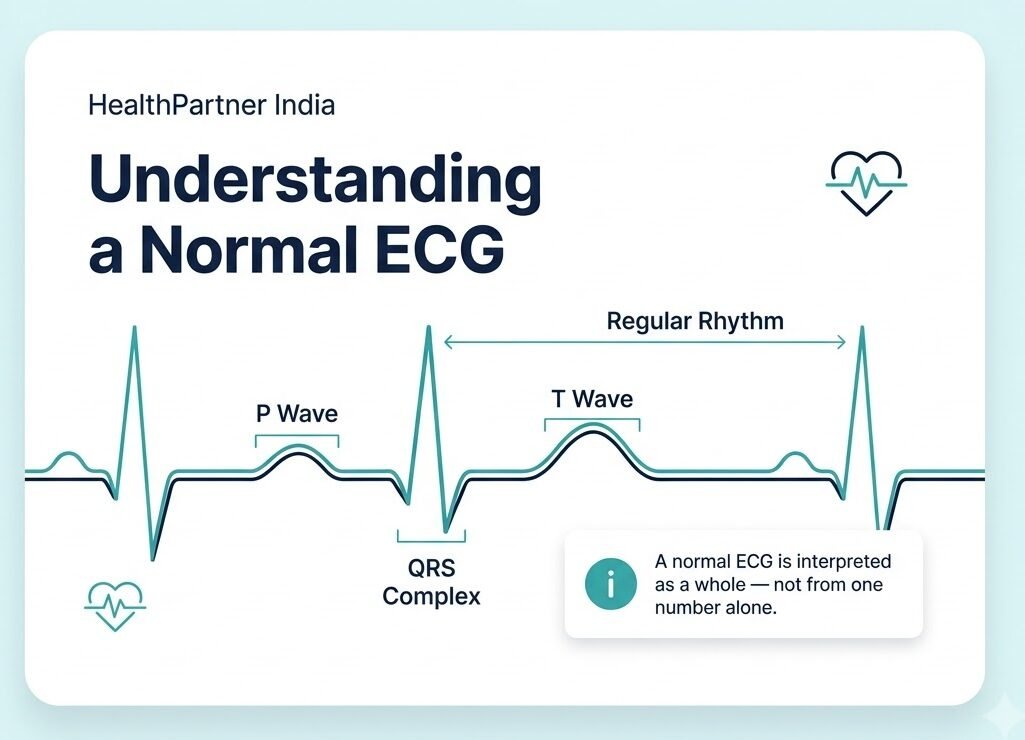
P Wave
The P wave represents electrical activity associated with activation of the upper chambers of the heart.
QRS Complex
The QRS complex represents electrical activity associated with activation of the lower chambers.
T Wave
The T wave represents electrical recovery after the contraction of the lower chambers.
These waveform components are important parts of ECG interpretation.
PR Interval, QRS Duration and QT/QTc
Some ECG reports also provide measurements such as:
- PR interval
- QRS duration
- QT interval
- QTc
These measurements describe different parts of the timing of electrical activity through the heart.
Their interpretation depends on factors such as heart rate, age, medicines and the clinical situation.
Do not diagnose yourself based on one ECG number.
What Is a Normal ECG?
A normal ECG generally shows an appropriate heart rate and rhythm without significant abnormal electrical patterns.
However, there is no single number that determines whether an ECG is completely normal.
A healthcare professional may consider:
- Heart rate
- Rhythm
- P waves
- QRS complex
- PR interval
- QT/QTc
- ST and T wave patterns
- Symptoms
- Medical history
- Other test results
A standard ECG is also a short recording. Some heart problems may not appear during the brief period when the ECG is recorded.
What Does an Abnormal ECG Mean?
An abnormal ECG does not automatically mean that a serious heart disease is present.
Possible causes of abnormal ECG findings can include:
- Abnormal heart rhythms
- Electrical conduction problems
- Changes associated with heart muscle injury
- Electrolyte abnormalities
- Certain heart conditions
- Medicines
- Technical factors
- Other medical conditions
The exact meaning depends on the specific ECG finding and the person’s symptoms and medical history.
A healthcare professional should interpret the complete ECG rather than relying only on an automated statement printed by the machine.
Can an ECG Detect Atrial Fibrillation?
Yes. An ECG can detect patterns consistent with atrial fibrillation (AFib) when the abnormal rhythm is occurring during the recording.
AFib is an irregular heart rhythm.
However, some rhythm problems occur intermittently. If the abnormal rhythm is not occurring during the ECG appointment, a short ECG may not capture it.
Longer monitoring may sometimes be recommended when symptoms continue.
What Is Bradycardia on an ECG?
Bradycardia generally means a slower-than-expected heart rate.
A slower heart rate does not automatically mean there is a heart problem. The significance depends on factors such as symptoms, age, fitness, medicines and other ECG findings.
A healthcare professional can determine whether further evaluation is needed.
Can an ECG Detect a Heart Attack?
An ECG is an important test when a heart attack is suspected and can show electrical changes associated with some heart attacks.
However, healthcare professionals generally interpret ECG findings together with:
- Symptoms
- Physical examination
- Blood tests such as cardiac troponin
- Other investigations when required
Therefore, an ECG should not be interpreted on its own.
Can an ECG Detect Blocked Arteries?
An ECG can provide clues about heart muscle injury or reduced blood supply in some situations, but it does not directly show every blockage in the coronary arteries.
Depending on the person’s symptoms and clinical situation, additional tests may include:
- Blood tests
- Echocardiography
- Exercise stress testing
- Coronary CT angiography
- Coronary angiography
- Other cardiac imaging
The appropriate investigation depends on the individual situation.
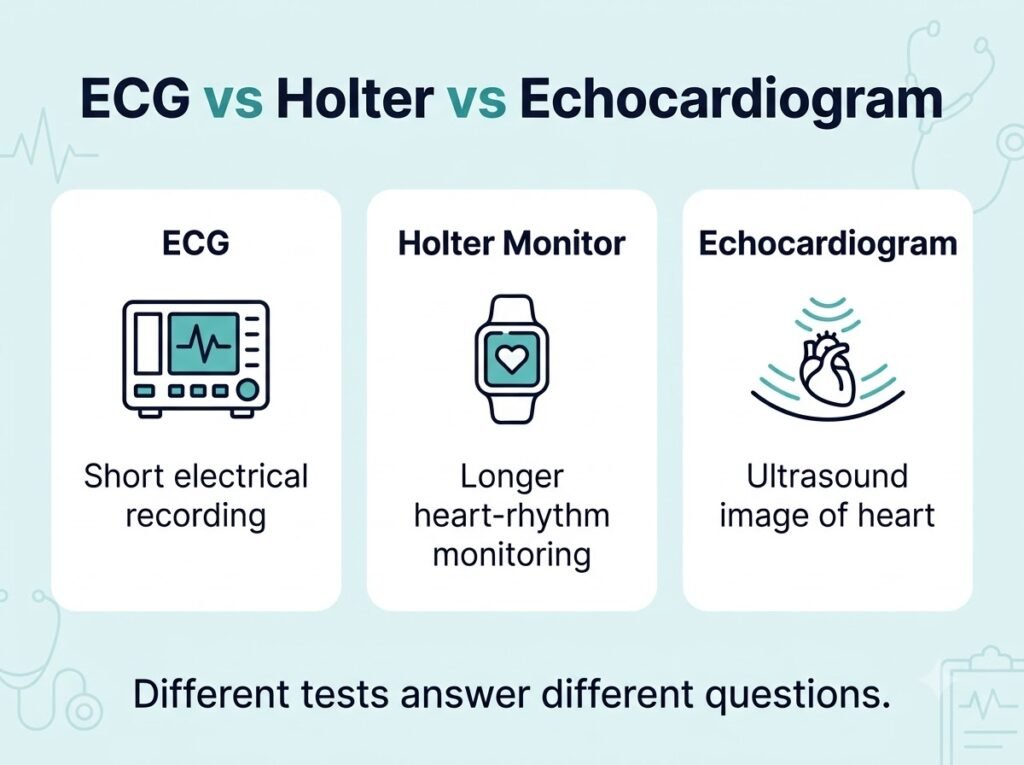
ECG vs Holter Monitor
| Test | Main purpose |
|---|---|
| Resting ECG | Short recording of electrical activity |
| Holter monitor | Longer continuous heart-rhythm recording |
| Event monitor | Longer monitoring that may help capture intermittent symptoms |
A standard ECG is essentially a short snapshot of heart activity. A portable monitor can record the rhythm for a much longer period and may identify abnormalities that do not occur during a short ECG.
ECG vs Echocardiogram
An ECG and an echocardiogram are different tests.
| ECG | Echocardiogram |
|---|---|
| Records electrical activity | Uses ultrasound |
| Shows heart rate and rhythm | Shows heart structure and movement |
| Produces electrical waveforms | Produces images of the heart |
| Useful for electrical/rhythm assessment | Useful for structural and functional assessment |
The two tests answer different questions and may sometimes be used together. The American Heart Association describes ECG as measuring electrical activity, while echocardiography uses ultrasound to study the heart’s structure and motion.
What If Your ECG Is Normal but Symptoms Continue?
A standard ECG records the heart’s electrical activity for only a short period.
If symptoms such as palpitations, dizziness or irregular heartbeat come and go, the abnormal rhythm may not occur during the ECG.
In such situations, a healthcare professional may consider longer monitoring, such as:
- Holter monitoring
- Event monitoring
- Longer ambulatory ECG monitoring
- Other cardiac investigations
The appropriate next step depends on your symptoms and clinical assessment.
Can an ECG Be Done During Pregnancy?
A standard ECG records electrical activity and does not use X-rays.
It may be performed during pregnancy when clinically indicated. Tell the healthcare professional that you are pregnant so your overall evaluation can be planned appropriately.
ECG Test Cost in India
The ECG test cost in India varies depending on factors such as:
- City
- Laboratory or hospital
- Type of ECG
- Resting or exercise ECG
- Home-visit availability
- Whether professional interpretation is included
Because prices and availability can change, it is better to confirm the current price before booking rather than relying on an old online price.
HealthPartner India can help you check available ECG and diagnostic-test options through its healthcare partner network.
Our current partner network includes:
- Tata 1mg
Availability, pricing, discounts and home-service options may vary by location and provider.
Send your city and test requirement on WhatsApp, and we can help you check the available options.
Can You Get an ECG Test at Home?
Some healthcare providers offer home ECG services, but availability depends on your city and provider.
Before booking a home ECG, confirm:
- Whether a trained technician will visit
- Whether it is a standard resting ECG
- Whether professional interpretation is included
- The total cost including the home visit
- How and when the report will be delivered
HealthPartner India can help you check available options through our partner network.
When Is Chest Pain an Emergency?
Do not wait for a routine ECG appointment if you have symptoms that could indicate a medical emergency.
Seek urgent medical care if you experience symptoms such as:
- Severe or persistent chest pressure or pain
- Chest discomfort spreading to the arm, jaw, neck, back or shoulder
- Severe difficulty breathing
- Fainting
- Chest pain accompanied by sweating, nausea or marked dizziness
A suspected heart attack requires urgent medical assessment.
How to Prepare for an ECG Test
Before a standard ECG:
- Wear clothing that allows easy access to your chest.
- Avoid heavy creams, oils or lotions on areas where electrodes will be placed.
- Tell the healthcare professional about medicines and supplements you take.
- Do not stop any medicine unless instructed by your healthcare professional.
- Follow separate instructions if you are scheduled for an exercise ECG.
The NHS also advises wearing clothing that is easy to remove and avoiding lotions, oils or talcum powder before an ECG.
Key Takeaways
- ECG stands for electrocardiogram.
- ECG and EKG refer to the same test.
- An ECG records the electrical activity of the heart.
- It is usually quick and painless.
- An ECG does not send electricity into your body.
- Fasting is usually not required for a standard resting ECG.
- An ECG can help assess heart rate, rhythm and electrical abnormalities.
- A normal ECG does not rule out every heart problem.
- Intermittent rhythm problems may require longer monitoring such as a Holter monitor.
- ECG and echocardiography provide different types of information.
- ECG cost varies by location, provider and type of test.
- Severe or persistent chest pain requires urgent medical assessment rather than waiting for a routine ECG.
Related HealthPartner Guides
You may also find these HealthPartner India guides useful:
- Blood Pressure Range: Normal, High & Low
- Hypertension: Symptoms, Causes & Treatment
- High Cholesterol: Symptoms, Causes & Treatment
- How to Read a Lipid Profile Report
- Complete Blood Count (CBC): Normal Range
- Kidney Function Test (KFT): Normal Range & Cost
How HealthPartner India Can Help
Need to book an ECG test, lab test, medicine or health service?
HealthPartner India can help you check available options through our healthcare partner network, including:
Availability, pricing, discounts and home-service options can vary by location and provider.
Send your city and test requirement on WhatsApp, and we can help you check the available options.
Contact HealthPartner India on WhatsApp
Frequently Asked Questions
1. What is the ECG full form?
ECG stands for electrocardiogram. It is a test that records the electrical activity of the heart. EKG is another name for the same test.
2. Is an ECG test painful?
No. A standard ECG is usually painless. The electrodes record the electrical activity produced by your heart and do not send electricity into your body.
3. How long does an ECG test take?
The ECG recording usually takes only a few minutes, although the complete appointment may take longer because of preparation and electrode placement.
4. Do I need to fast before an ECG test?
Usually not for a standard resting ECG. If you are having other tests at the same appointment, follow the preparation instructions provided by your healthcare professional or laboratory.
5. What is a normal ECG?
A normal ECG generally shows an appropriate heart rate and rhythm without significant abnormal electrical patterns. However, there is no single number that determines whether an ECG is completely normal.
6. What does an abnormal ECG mean?
An abnormal ECG can have many possible causes and does not automatically mean serious heart disease. A qualified healthcare professional should interpret the specific finding together with symptoms and medical history.
7. Can an ECG detect a heart attack?
An ECG is an important test when a heart attack is suspected, but healthcare professionals generally use it together with symptoms, examination and blood tests such as troponin.
8. Can an ECG detect blocked arteries?
An ECG can show certain changes associated with reduced blood supply or heart injury, but it cannot directly show every coronary artery blockage. Additional tests may be required.
9. What is the difference between ECG and Holter monitor?
A standard ECG records the heart’s electrical activity for a short period. A Holter monitor records heart rhythm continuously for a longer period, commonly 24–48 hours or longer.
10. What is the difference between ECG and echocardiogram?
An ECG records electrical activity, while an echocardiogram uses ultrasound to create images of the heart’s structure and movement.
11. What is bradycardia on an ECG?
Bradycardia generally means a slower-than-expected heart rate. Whether it requires evaluation depends on symptoms, medical history, medicines and other findings.
12. What is AFib on an ECG?
AFib, or atrial fibrillation, is an irregular heart rhythm that can produce characteristic ECG findings when the rhythm is occurring during the test.
13. Can an ECG be done during pregnancy?
Yes, when clinically indicated. A standard ECG records electrical activity and does not use X-rays.
14. Can I get an ECG test at home?
Home ECG services may be available in some locations, depending on the provider. Confirm availability, total cost and whether professional interpretation is included before booking.
15. How much does an ECG test cost in India?
ECG prices vary by city, provider, test type and whether home service or professional interpretation is included. Contact the laboratory or healthcare provider for the current price.
Medical Disclaimer
This article is for general educational and informational purposes only and does not constitute medical advice, diagnosis or treatment.
An ECG report should be interpreted by a qualified healthcare professional together with your symptoms, medical history and other relevant tests.
Do not start, stop or change medicines based only on an ECG report or information in this article.
If you have severe or persistent chest pain, difficulty breathing, fainting or other symptoms that may indicate a medical emergency, seek urgent medical care.
Medical References
- American Heart Association — Electrocardiogram (EKG or ECG)
- MedlinePlus — Electrocardiogram
- MedlinePlus — Electrocardiogram Medical Encyclopedia
- NHS — Electrocardiogram (ECG)
About HealthPartner India: HealthPartner India is a healthcare assistance service that helps customers access and book medicines, lab tests and health services through its partner network. HealthPartner India does not provide medical diagnosis or treatment.