
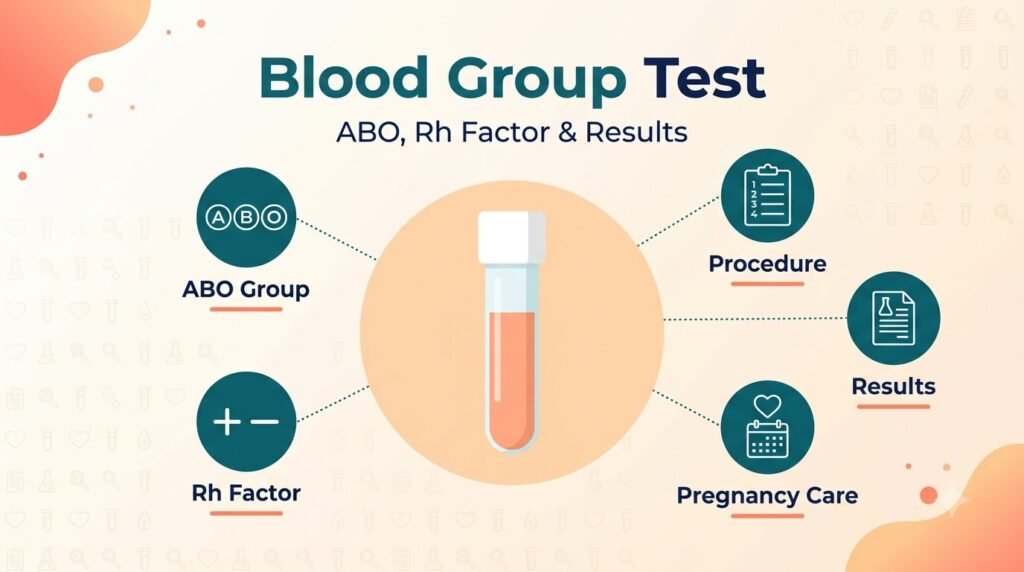
A blood group test identifies your ABO blood group and usually your RhD status. The result is commonly reported as A+, A−, B+, B−, AB+, AB−, O+ or O−. Knowing your blood group is important when a blood transfusion may be needed, and it is a routine part of antenatal care during pregnancy.
The test generally involves collecting a small blood sample and does not usually require fasting when performed on its own. However, a blood group result is not a complete check of your health, and it does not by itself confirm that a particular donor’s blood is suitable for you. Blood banks perform additional compatibility checks when necessary.
This guide explains the ABO blood group system, Rh factor, how the test is done, preparation, how to read your result, cost considerations and why blood typing matters in pregnancy.
📌 Quick Summary
| Question | Key point |
|---|---|
| What does a blood group test check? | The ABO blood group and usually RhD-positive or RhD-negative status. |
| Is fasting required? | Usually not for a standalone blood group test. Follow instructions for any additional tests. |
| What do the results look like? | Common results include A+, A−, B+, B−, AB+, AB−, O+ and O−. |
| Does blood typing guarantee a safe transfusion? | No. Additional antibody screening and compatibility testing may be necessary. |
| Why is blood grouping important during pregnancy? | RhD status and red-cell antibodies can influence antenatal care and follow-up. |
| Can a blood group test detect anaemia? | No. A complete blood count (CBC) is used to assess blood cell measurements. |
What Is a Blood Group Test?
A blood group test, also called blood typing or ABO and Rh typing, identifies certain markers called antigens on red blood cells. These markers help healthcare professionals determine your blood group and assess compatibility requirements in situations such as transfusion.
The two main systems considered in routine blood grouping are:
- ABO system: Classifies blood into groups A, B, AB and O.
- RhD system: Identifies whether the RhD antigen is present or absent according to routine testing.
Combining these results produces the eight commonly reported blood groups, such as A positive or O negative.
Your blood group is inherited from your biological parents. It is not a measure of your fitness, immunity, personality or overall health. The result is useful medical information, but it cannot replace other investigations recommended for your symptoms or medical history.
Why Might a Doctor Recommend a Blood Group Test?
A healthcare professional may recommend blood grouping for several reasons.
- Before a blood transfusion: Blood grouping is an important part of identifying suitable blood components and planning compatibility checks.
- During pregnancy: Blood group and RhD status help guide antenatal care. An antibody screen may also be recommended.
- Before certain procedures: The treating team may need blood group information when a procedure carries a possibility of requiring a transfusion.
- For blood donation: Blood centres determine a donor’s blood group and perform separate screening required for donation.
- For medical records: Testing may be useful when your blood group is undocumented or a previous result needs confirmation.
The reason for testing determines whether ABO/Rh typing alone is sufficient or whether additional investigations are needed.
A blood group test is different from a complete blood count (CBC), which measures red blood cells, white blood cells, platelets and related values.
Understanding the ABO Blood Group System
The ABO system has four main groups: A, B, AB and O. They are based on whether A and B antigens are present on red blood cells.
| ABO group | Red-cell antigens | General meaning |
|---|---|---|
| A | A antigen | Red blood cells carry A antigen. |
| B | B antigen | Red blood cells carry B antigen. |
| AB | A and B antigens | Red blood cells carry both A and B antigens. |
| O | Neither A nor B antigen | Red blood cells do not carry A or B antigens. |
Laboratories use specific reagents to check how a blood sample reacts with particular red-cell antigens. Complementary testing may be used to confirm the result when needed.
This table explains the basic ABO system only. It should not be used to choose blood for a transfusion because other compatibility factors also matter.
What Does Rh Positive or Rh Negative Mean?
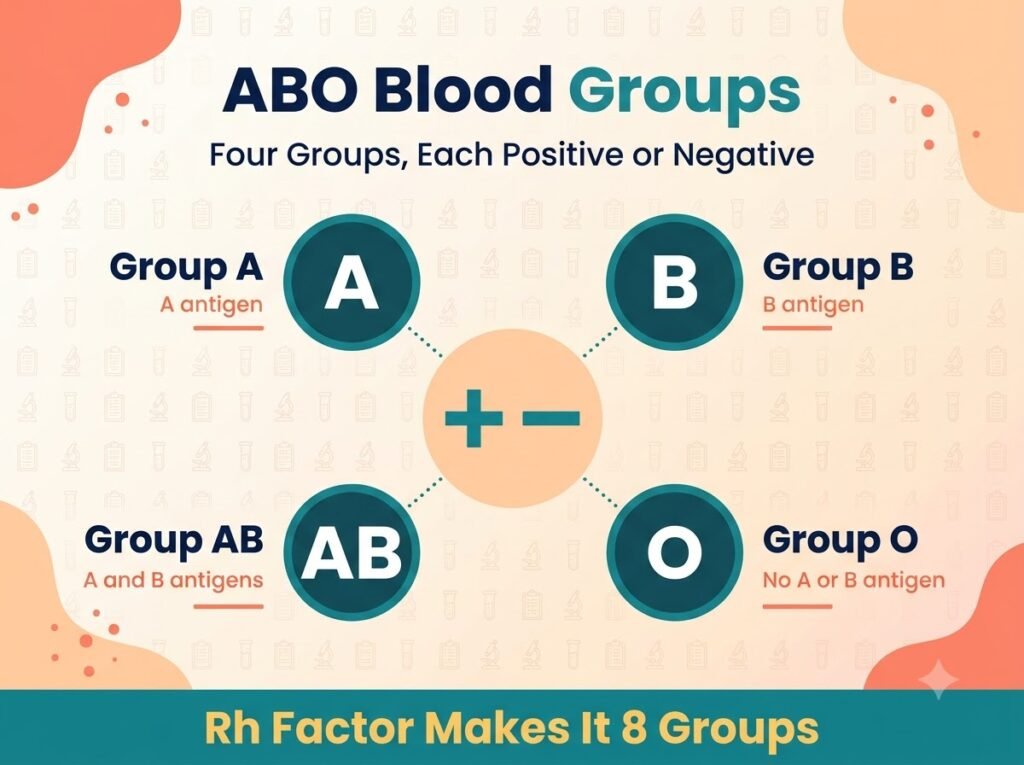
The RhD system identifies whether a particular antigen, called the D antigen, is present on red blood cells.
- Rh positive (+): The RhD antigen is detected.
- Rh negative (−): The RhD antigen is not detected by the routine test.
Combining ABO group with RhD status gives eight common results:
- A positive (A+)
- A negative (A−)
- B positive (B+)
- B negative (B−)
- AB positive (AB+)
- AB negative (AB−)
- O positive (O+)
- O negative (O−)
Being Rh negative is not an illness and does not usually cause symptoms. However, RhD status is important in situations such as blood transfusion and pregnancy because it can affect compatibility decisions and clinical management.
Sometimes a laboratory runs extra checks when the routine RhD result is unclear, for example when only a weak form of the RhD antigen is present. The laboratory and your treating clinician handle this, so you do not need to interpret it yourself.
How Is a Blood Group Test Performed?
A blood group test is generally a straightforward laboratory investigation.
1. Blood Sample Collection
A trained healthcare professional usually collects a small blood sample from a vein in your arm using a sterile needle. Some testing settings may use a finger-prick sample.
2. Laboratory Testing
The sample is tested with reagents that react with specific antigens on red blood cells. For ABO grouping, laboratories commonly check both the red blood cells (for A and B antigens) and the liquid part of the blood, called serum (for the matching antibodies). Using both checks helps confirm the result. The pattern of reactions also helps identify RhD status.
3. Result Verification
The laboratory interprets the reaction pattern and performs any additional checks required by its procedures or the clinical situation. Further confirmation may be needed if the result is unclear or differs from an earlier report.
4. Reporting the Result
The laboratory reports the identified blood group and RhD status according to the test performed.
You may feel a brief prick during sample collection. Mild soreness or a small bruise can occur afterwards. Serious complications from routine blood collection are uncommon.
If you have previously felt faint during a blood test or have difficulty with blood draws, tell the collection staff before the procedure.
Do You Need Fasting or Special Preparation?
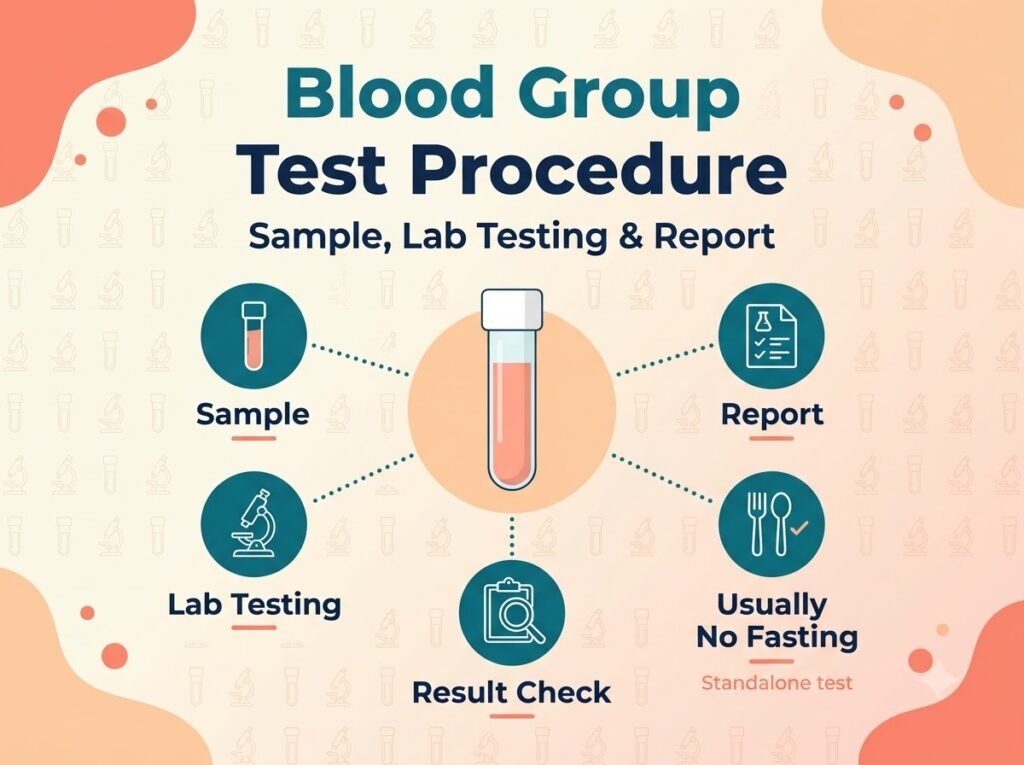
A standalone blood group test generally does not require fasting. You can usually eat and drink normally unless your healthcare professional or laboratory gives different instructions because other tests are being performed at the same time.
Before the test, consider these practical points:
- Tell the healthcare professional if you have previously received a blood transfusion.
- Mention if you have been told that you have red-cell antibodies.
- If you are pregnant or have a relevant pregnancy history, share this information with your antenatal team.
- Check that your name and other identifying details on the request form and sample label are correct.
- Keep a copy of your report for your records.
An old blood group card can be useful information, but a hospital may still need fresh samples and current compatibility testing before a transfusion.
Report turnaround time varies between laboratories and may depend on whether additional testing is required. Ask the testing centre about its reporting process.
How to Read Blood Group Test Results
A blood group report commonly identifies the ABO group and RhD status.
For example:
- B positive (B+): The ABO group is B, and the RhD antigen is detected.
- O negative (O−): The ABO group is O, and the RhD antigen is not detected by routine testing.
- AB positive (AB+): The red blood cells carry A and B antigens, and the RhD antigen is detected.
- A negative (A−): The ABO group is A, and the RhD antigen is not detected by routine testing.
A blood group is a classification rather than a numerical measurement such as haemoglobin or blood glucose. There is no high or low blood group result in the usual sense.
If your report says that the result is inconclusive or differs from a previous report, contact the laboratory or your healthcare professional. Do not assume that your blood group has changed without proper confirmation.
Blood Group Test Cost in India
A standalone blood group test is generally a routine, low-cost blood test, but the price differs between laboratories, cities and collection methods. It may also be bundled into antenatal panels, pre-surgery checks or health packages, so the separate price can look different from one provider to another.
Before booking, it helps to ask:
- Does the price include both the ABO group and the RhD (Rh factor) status?
- Is there an extra charge for home sample collection?
- When will the report be ready, especially if you need it for a procedure or an antenatal visit?
- Can the test be added to other tests you are already booking?
Choose a laboratory with a good quality record, for example one that is accredited by a recognised body such as NABL, rather than choosing on price alone. A hospital may still repeat the test before a transfusion.
Blood Group Test vs Antibody Screen vs Crossmatch vs CBC
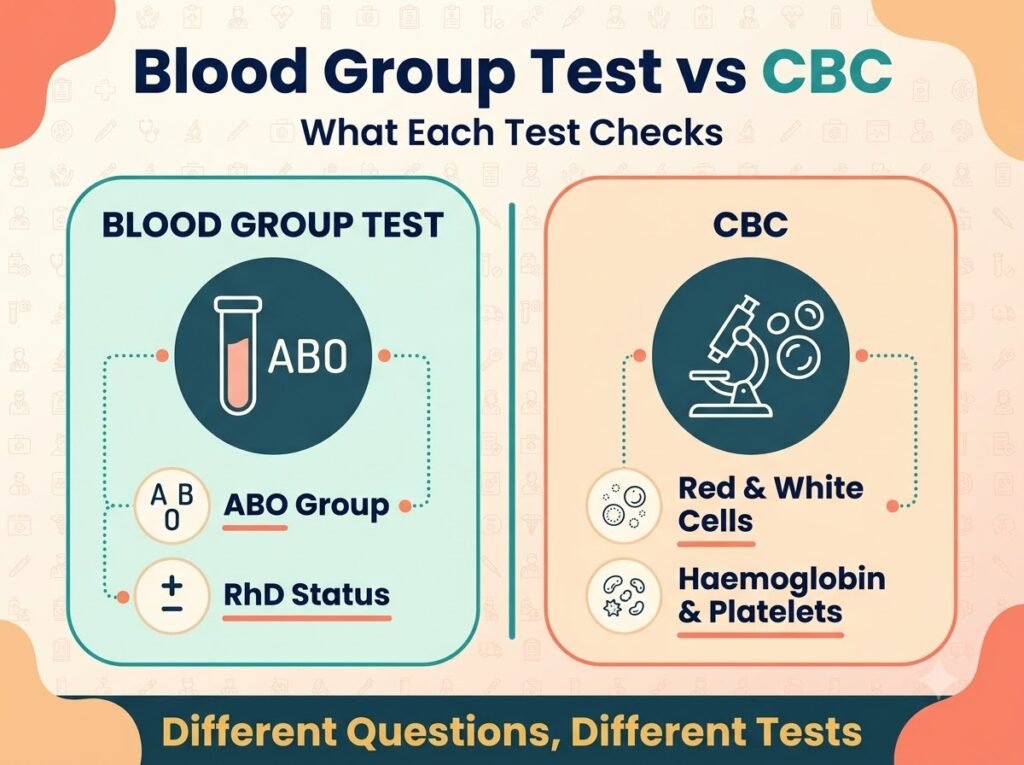
These tests serve different purposes, particularly when a blood transfusion or pregnancy-related assessment is involved.
| Test | What it checks | Why it matters |
|---|---|---|
| ABO/Rh blood group test | Identifies the main ABO group and RhD status. | Provides important information for transfusion planning and pregnancy care. |
| Red-cell antibody screen | Looks for certain antibodies that may react with red blood cells. | Helps identify additional compatibility concerns, including during pregnancy. |
| Crossmatch or compatibility testing | Checks compatibility between selected donor blood and the recipient according to blood-bank procedures. | Helps reduce the risk of a transfusion reaction. |
| Complete blood count (CBC) | Measures red cells, white cells, platelets and related values. | Helps assess conditions such as anaemia but does not determine ABO/Rh group by itself. |
Important: Knowing that two people have the same blood group does not mean they should arrange a transfusion directly. Hospitals and licensed blood centres follow identification, laboratory testing and compatibility procedures. The treating team makes transfusion decisions according to established protocols and the patient’s clinical circumstances.
For more information about blood cell testing, read our guide to the Complete Blood Count (CBC) Test: Normal Range & How to Read Your Report.
Blood Group Testing During Pregnancy
Blood group and RhD status are important parts of antenatal care. Doctors usually check them early in pregnancy, often at the first antenatal visit, and may also recommend a red-cell antibody screen to identify antibodies that could affect the pregnancy or future transfusion needs.
If a pregnant person is RhD negative and the baby may be RhD positive, the antenatal team will assess whether preventive treatment, repeat testing or additional monitoring is appropriate. This may include an anti-D (Rh immune globulin) injection if your doctor decides it is suitable for you.
Rh incompatibility does not mean that a pregnancy will automatically develop complications. Concerns are generally linked to antibodies that can form after the mother’s immune system is exposed to RhD-positive blood, which is why follow-up and timing matter. Management depends on the person’s blood group, antibody results, pregnancy history and applicable clinical guidance.
If you are pregnant and your report says Rh negative, discuss the result with your obstetrician or antenatal clinic. Do not delay routine antenatal care or start or skip any treatment on your own.
For broader screening information, see our guide to Women’s Health Checkup in India: Essential Tests by Age, Screening & Preparation.
Does Blood Group Tell You Which Blood You Can Receive?
ABO and RhD results are essential, but they are not the only factors used to select blood for transfusion.
Other red-cell antigens and antibodies can affect compatibility. The checks required depend on the blood component being transfused, the recipient’s history and the clinical situation.
O negative red cells are often used in certain emergencies when a person’s blood group is not yet known. However, the term “universal donor” is an oversimplification and does not mean that O negative blood is automatically suitable in every situation or for every blood component.
Only the treating team and blood bank should select blood for transfusion.
Blood donation also involves separate screening for transfusion-transmissible infections. A blood group result alone does not establish whether donated blood has passed all required infection screening.
For India-specific information, consult the Indian Red Cross Society Blood Services page and the Transfusion Medicine Technical Manual (3rd edition, 2023) from the Directorate General of Health Services, Government of India.
When Should You Speak With a Healthcare Professional?
Consider discussing your blood group test with a healthcare professional if:
- You are pregnant and have not discussed your blood group or RhD result with your antenatal team.
- You are preparing for surgery or a possible transfusion and have questions about required tests.
- Your current result differs from a previous report.
- The laboratory has requested a repeat sample or additional testing.
- You have previously received a blood transfusion or have been told that you have red-cell antibodies.
- You need help understanding the difference between blood grouping, a CBC and other blood investigations.
A blood group result alone is not an emergency diagnosis. If you are acutely unwell, have severe bleeding or experience symptoms that require urgent assessment, seek appropriate emergency care rather than waiting for a blood group report.
Frequently Asked Questions About Blood Group Tests
1. Is a blood group test painful?
A blood group test usually involves a brief needle prick if blood is collected from a vein. Some people experience mild soreness or a small bruise afterwards. Serious complications from routine blood collection are uncommon.
2. Can my blood group change during my lifetime?
Your inherited blood group generally remains the same. In rare situations, such as after a bone marrow or stem cell transplant, the reported blood group can change, and the transplant team will explain this. If two reports differ and neither of these applies, the laboratory or blood bank should investigate and confirm the result rather than assuming your blood group has changed.
3. Is fasting required for a blood group test?
Usually not when the test is performed on its own. Follow the instructions provided by your healthcare professional or laboratory if it is combined with other tests that require preparation.
4. Is O negative blood always suitable for everyone?
No. O negative red cells may be used in particular emergencies, but blood banks still follow component-specific protocols and compatibility checks. The treating team and blood bank must determine which blood component is appropriate.
5. Can a blood group test detect anaemia?
No. A blood group test identifies ABO and RhD status. A complete blood count (CBC) and other investigations may be used to assess anaemia. Read our CBC test guide and our guide to iron deficiency symptoms, tests and treatment for more information.
6. Does my blood group tell me my overall health?
No. Blood group is one piece of medical information. It does not diagnose a disease or replace health checks recommended according to your age, symptoms and medical history. You can also read our guide to choosing a full body health checkup.
7. Should I carry my blood group report?
Keeping a copy can be useful for your medical records. However, hospitals may repeat identification and compatibility testing before a transfusion according to their safety protocols. Do not delay emergency care while looking for an old report.
8. What is the difference between blood group and Rh factor?
Blood group (ABO) describes whether A and B antigens are present on your red blood cells. Rh factor, usually the RhD antigen, is a separate marker that is either present (positive) or not detected (negative). Reports combine the two, for example A+ or O−.
9. How long does it take to get a blood group test report?
Turnaround time varies between laboratories and depends on whether additional checks are needed. Ask the testing centre about its reporting time when you book, especially if you need the result for a procedure or an antenatal visit.
10. Can I get a blood group test done at home?
Some laboratories offer home sample collection, where a trained professional collects the blood sample at your address and it is tested in the laboratory. Simple at-home card or kit tests may also exist, but a laboratory report is what healthcare teams generally rely on, and hospitals may still repeat testing before a transfusion.
11. Do I need a blood group test before surgery?
It depends on the procedure and your hospital’s policy. When a transfusion could be needed, the treating team usually arranges blood group testing and any other pre-transfusion checks, and may ask for a fresh sample even if you already have a report. Ask your surgical or anaesthesia team which tests they need.
12. If I am Rh negative and pregnant, is my baby in danger?
Being Rh negative does not by itself mean your baby is in danger. The risk depends on factors such as the baby’s RhD status, whether you have developed antibodies and your pregnancy history. Your antenatal team will check your results and advise whether any preventive treatment or extra monitoring is needed. Do not delay routine antenatal care or start any treatment on your own.
Final Takeaway
A blood group test identifies your ABO group and RhD status, usually without fasting or special preparation. The result is important for transfusion planning, blood donation procedures and pregnancy care, but it does not measure your overall health or guarantee compatibility with donor blood.
If your result is unclear, differs from an earlier report or raises questions during pregnancy or before a procedure, ask your healthcare professional or laboratory to explain the next step.
Understanding your blood group can help you maintain useful medical records, but transfusion and pregnancy-related decisions should always be guided by qualified healthcare professionals.
Related Reading
- Complete Blood Count (CBC) Test: Normal Range & How to Read Your Report
- Full Body Health Checkup: What’s Included, Who Needs One & How to Choose
- Women’s Health Checkup in India: Essential Tests by Age, Screening & Preparation
Medical References
The following established medical resources provide further information about blood typing, RhD status and transfusion safety.
- MedlinePlus: Blood Typing — an overview of ABO/Rh typing, sample collection, preparation and transfusion considerations.
- NHS: Blood Groups — information about ABO groups, RhD status, the eight blood groups, blood group testing and pregnancy.
- MedlinePlus: Rh Incompatibility — information about Rh status, screening and care during pregnancy.
- Directorate General of Health Services, Government of India: Transfusion Medicine Technical Manual (3rd edition, 2023) — technical guidance on ABO and Rh typing, compatibility testing and transfusion practice in India.
- Indian Red Cross Society: Blood Services — information about blood grouping with RhD and antibody testing, and infection screening of donated blood at IRCS blood centres.
Medical Disclaimer
This article is intended for general educational purposes only. It is not a substitute for individual medical advice, diagnosis or treatment. Test interpretation and transfusion decisions must be made by qualified healthcare professionals using the patient’s clinical information and appropriate laboratory and blood-bank procedures.
Need Help With Health Tests or Lab Bookings?
HealthPartner India can help readers enquire about available healthcare service options through Tata 1mg where offered. For assistance with laboratory booking options or understanding which service to ask about, contact us on WhatsApp. A healthcare professional should interpret medical results and advise on treatment.
WhatsApp: +91 93479 68950