
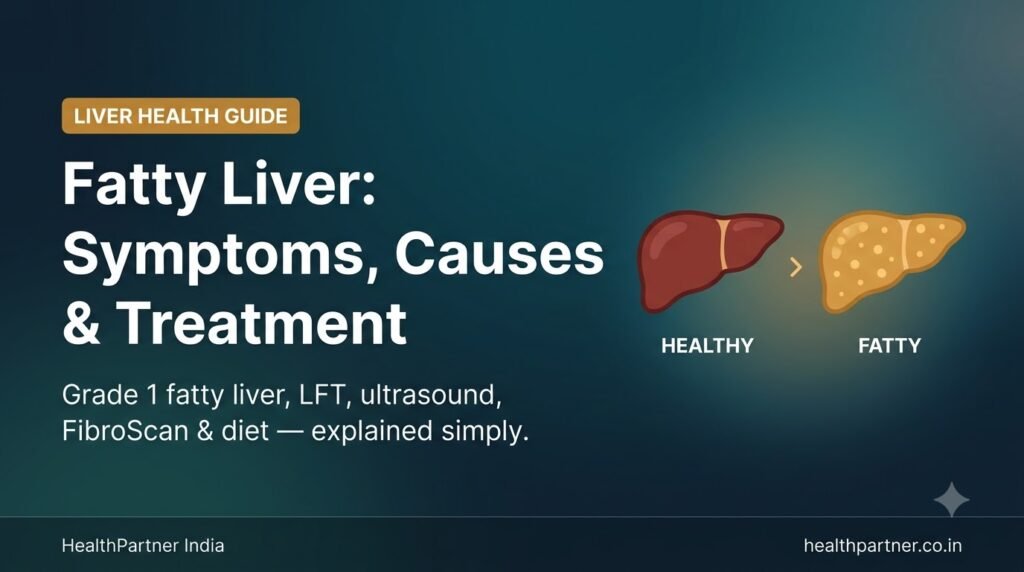
Fatty liver means that excess fat has accumulated in the liver.
It is common, and it often appears alongside metabolic conditions such as overweight or obesity, insulin resistance, type 2 diabetes, high triglycerides and abnormal cholesterol levels.
One important thing to know is that fatty liver often causes no obvious symptoms in its early stages. It is frequently discovered by accident — during a routine health checkup, a blood test or an abdominal ultrasound done for some other reason.
The good news is that finding fatty liver early gives you an opportunity to address the underlying risk factors and protect long-term liver health.
In this guide, we explain fatty liver symptoms, causes, Grade 1 fatty liver, LFT, ultrasound, FibroScan, FIB-4, diet, exercise, treatment and when to see a doctor.
📌 Quick Summary
| Aspect | Key Point |
|---|---|
| Medical term | Hepatic steatosis |
| Current metabolic term | MASLD — metabolic dysfunction-associated steatotic liver disease |
| Early symptoms | Often none |
| Common risk factors | Excess weight, diabetes, insulin resistance, abnormal blood lipids |
| Common tests | LFT, blood glucose/HbA1c, lipid profile, ultrasound |
| Grade 1 | Mild fatty accumulation on imaging |
| Can it improve? | Liver fat can decrease with appropriate lifestyle and medical management |
| FibroScan | May help assess liver stiffness / fibrosis risk |
| Treatment | Depends on the cause, severity and individual risk |
| Important | Ultrasound grade alone does not tell the full story about liver fibrosis |
What Is Fatty Liver?
Fatty liver, also called hepatic steatosis, occurs when excess fat accumulates in liver cells.
Fat can build up in the liver for different reasons.
When liver fat is associated with metabolic risk factors such as excess weight, type 2 diabetes or abnormal blood lipids, doctors may use the term metabolic dysfunction-associated steatotic liver disease (MASLD). This is the newer term that has largely replaced the older label “NAFLD” (non-alcoholic fatty liver disease) in medical literature.
Alcohol can also contribute to liver fat and liver injury.
This is why “fatty liver” is best understood as a broad description of a finding, not a complete diagnosis.
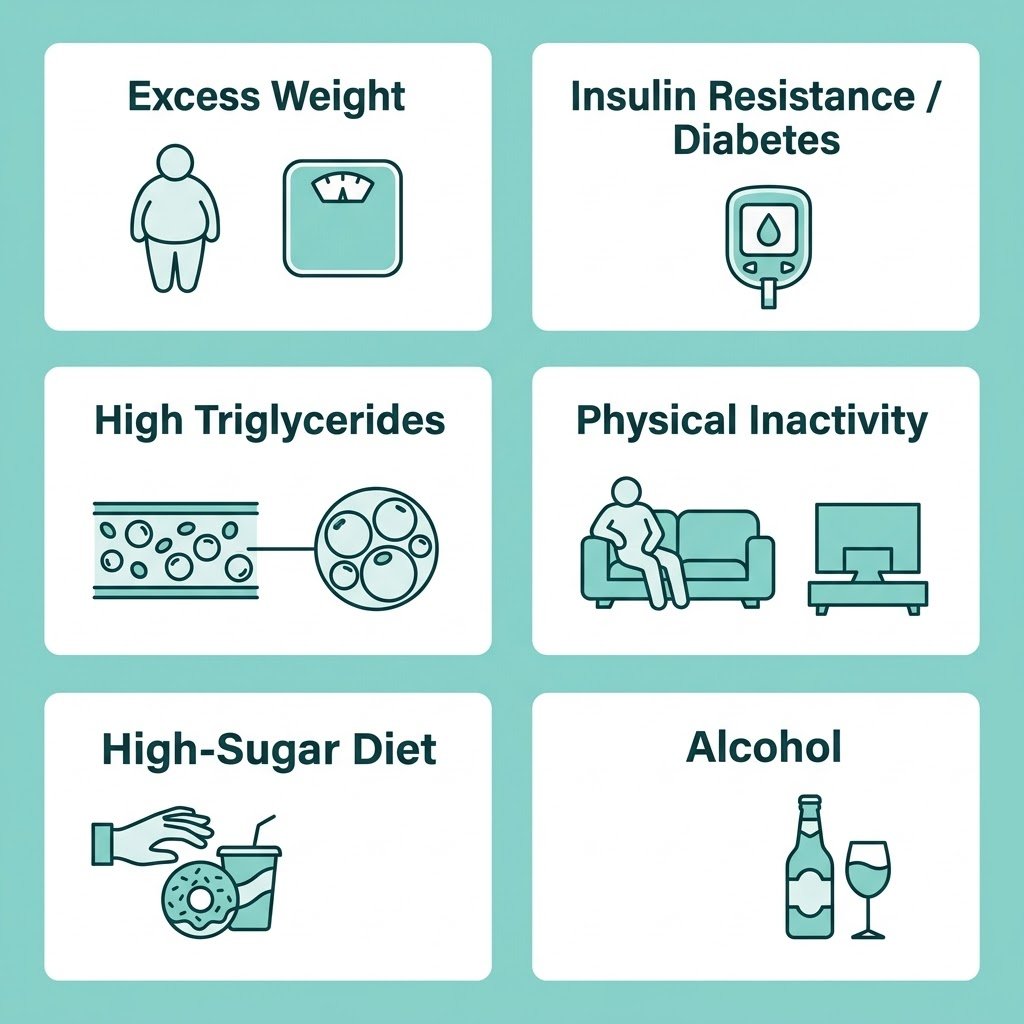
What Causes Fatty Liver?
Several factors can increase the likelihood of developing fatty liver.
1. Excess Weight or Obesity
Excess body fat, especially around the abdomen, is associated with a higher risk of fatty liver.
2. Insulin Resistance and Type 2 Diabetes
Insulin resistance and type 2 diabetes are among the most important metabolic risk factors linked with liver fat.
If you are concerned about blood sugar, read:
What Is Diabetes? Symptoms, Causes & Early Diagnosis
and
HbA1c Test: Normal Range, Prediabetes & Diabetes Levels
3. High Triglycerides or Abnormal Cholesterol
Abnormal blood lipids commonly occur alongside fatty liver.
Read: How to Read Your Lipid Profile Report
4. Physical Inactivity
Low physical activity can contribute to weight gain and metabolic problems.
5. Dietary Pattern
A diet consistently high in excess calories, sugary drinks and highly processed foods can contribute to metabolic health problems.
6. Alcohol
Alcohol can contribute to liver fat accumulation and liver injury.
7. Other Causes
Certain medicines, some medical conditions and rapid changes in body weight can also be associated with liver fat.
Your doctor should work out the likely cause rather than assuming fatty liver always has a single explanation.
What Are the Symptoms of Fatty Liver?
Many people with fatty liver have no symptoms at all.
When symptoms do occur, they may include:
- Fatigue
- Low energy
- General weakness
- Mild discomfort in the upper-right abdomen
These symptoms are not specific to fatty liver and can occur with many other conditions.
More advanced liver disease can produce symptoms such as:
- Yellowing of the skin or eyes
- Abdominal swelling
- Leg swelling
- Easy bruising or bleeding
- Significant unexplained weight loss
- Confusion or changes in mental alertness
These symptoms need medical assessment.
Is Fatty Liver Dangerous?
Fatty liver does not automatically mean cirrhosis or liver failure.
Some people have liver fat without significant liver injury. In others, liver fat is associated with inflammation and progressive scarring, known as fibrosis.
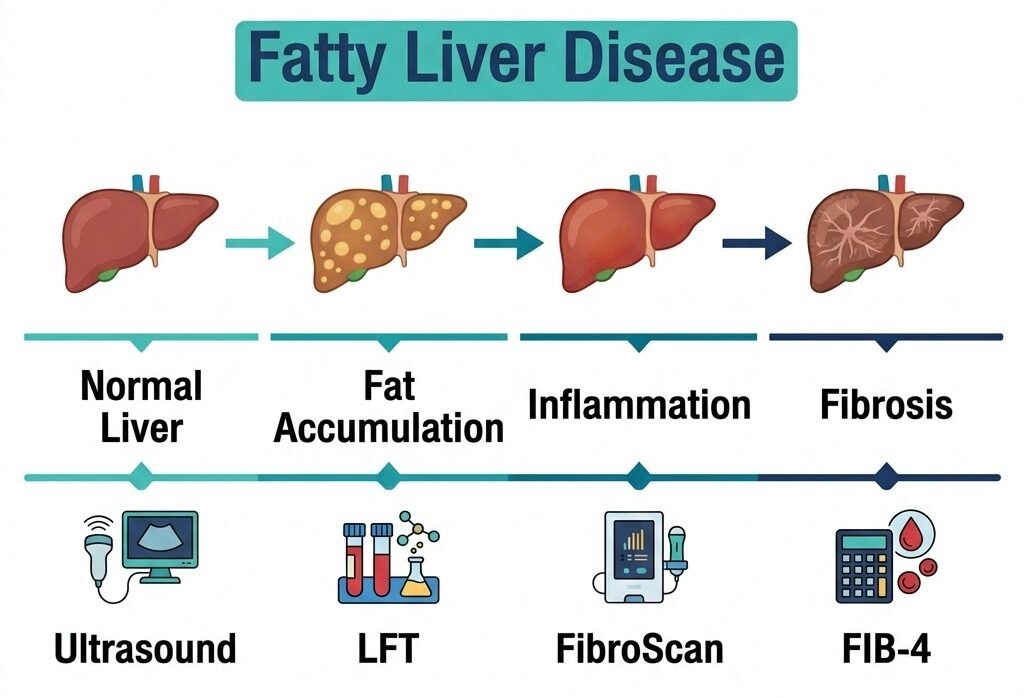
A simplified progression can look like this:
Fat accumulation → inflammation / liver injury in some people → fibrosis → advanced fibrosis or cirrhosis in some cases
Not everyone moves through all these stages.
This is exactly why identifying people at higher risk of liver fibrosis matters more than the word “fatty liver” by itself.
What Is Grade 1 Fatty Liver?
Grade 1 fatty liver generally refers to mild fatty infiltration seen on imaging, most commonly an ultrasound. It is often discovered incidentally.
Grade 1 is usually the mildest ultrasound grade — but the ultrasound grade alone does not tell you whether there is liver inflammation or fibrosis.
Two people with the same “Grade 1 fatty liver” report can have very different overall risk, depending on:
- Weight
- Diabetes status
- HbA1c
- Cholesterol
- Triglycerides
- Blood pressure
- Liver enzymes
- Age
- Other medical conditions
So Grade 1 is best viewed as a finding that deserves proper follow-up, not as a complete diagnosis and not as a reason to panic.
Can Grade 1 Fatty Liver Improve?
In many people, liver fat can decrease when the underlying metabolic risk factors are addressed.
Appropriate measures may include:
- Gradual weight management when needed
- Regular physical activity
- A balanced, good-quality diet
- Managing diabetes
- Managing cholesterol and triglycerides
- Following medical advice for other conditions
- Avoiding harmful alcohol intake
The amount of weight change that may be helpful varies between individuals.
Avoid extreme crash diets or rapid weight-loss programmes without medical supervision.
How Is Fatty Liver Diagnosed?
Doctors usually put together several pieces of information.
1. Medical History
Your doctor may ask about weight, diet, exercise, alcohol, diabetes, cholesterol, blood pressure, medicines, supplements, family history and any previous liver problems.
2. Blood Tests
Depending on your situation, your doctor may order:
- ALT / SGPT
- AST / SGOT
- Bilirubin
- Albumin
- Platelet count
- Blood glucose
- HbA1c
- Lipid profile
However, liver enzymes alone cannot tell you how much fat is in the liver or whether significant fibrosis is present.
What Is an LFT?
A Liver Function Test (LFT) is a group of blood tests that gives information about several aspects of liver-related health.
It may include:
- ALT / SGPT
- AST / SGOT
- Bilirubin
- Alkaline phosphatase
- Albumin
- Total protein
Read our complete guide:
Liver Function Test (LFT): SGPT & SGOT Normal Range
Important: A normal ALT or AST does not automatically rule out fatty liver or significant liver disease. Your doctor will interpret the LFT together with your symptoms, risk factors and imaging.
Can a Blood Test Detect Fatty Liver?
Blood tests give useful information about liver enzymes and associated metabolic conditions.
However, a blood test alone generally cannot determine how much fat is present in the liver. Depending on the situation, imaging may be needed.
Ultrasound for Fatty Liver
An abdominal ultrasound is the test most commonly used to look for liver fat. It is:
- Non-invasive
- Widely available
- Generally painless
- Routinely used in clinical practice
However, ultrasound has limitations. It does not reliably measure fibrosis, and mild steatosis can sometimes be difficult to detect.
Your doctor may recommend additional assessment depending on your overall risk.
What Is FibroScan?
FibroScan, or transient elastography, is a non-invasive test that helps assess liver stiffness.
Liver stiffness gives information about the likelihood of liver fibrosis. Some FibroScan systems also provide a measurement associated with liver fat (CAP).
FibroScan is not simply another name for an ultrasound.
Whether you need it depends on your medical history, blood-test results, imaging and your doctor’s assessment.
What Is FIB-4?
FIB-4 is a non-invasive risk-assessment score that helps estimate the likelihood of significant liver fibrosis.
It uses:
- Age
- AST
- ALT
- Platelet count
FIB-4 is a risk-assessment tool, not a standalone diagnosis. A healthcare professional should interpret the result and decide whether further evaluation is needed.
Fatty Liver and Diabetes
Fatty liver and metabolic health are closely connected. People with insulin resistance and type 2 diabetes have an increased risk of fatty liver.
If fatty liver is detected, your doctor may consider checking:
- Fasting blood glucose
- HbA1c
- Lipid profile
- Blood pressure
- Body weight
- Other metabolic risk factors
Read: Normal Blood Sugar Level Chart: Fasting, Post-Meal & HbA1c
Fatty Liver and Cholesterol
Fatty liver frequently occurs alongside abnormal cholesterol and triglyceride levels, so a lipid profile is often useful when assessing overall metabolic health.
A lipid profile commonly includes:
- Total cholesterol
- LDL cholesterol
- HDL cholesterol
- Triglycerides
Read: How to Read Your Lipid Profile Report: Complete Guide
Fatty Liver Diet: What Should You Eat?
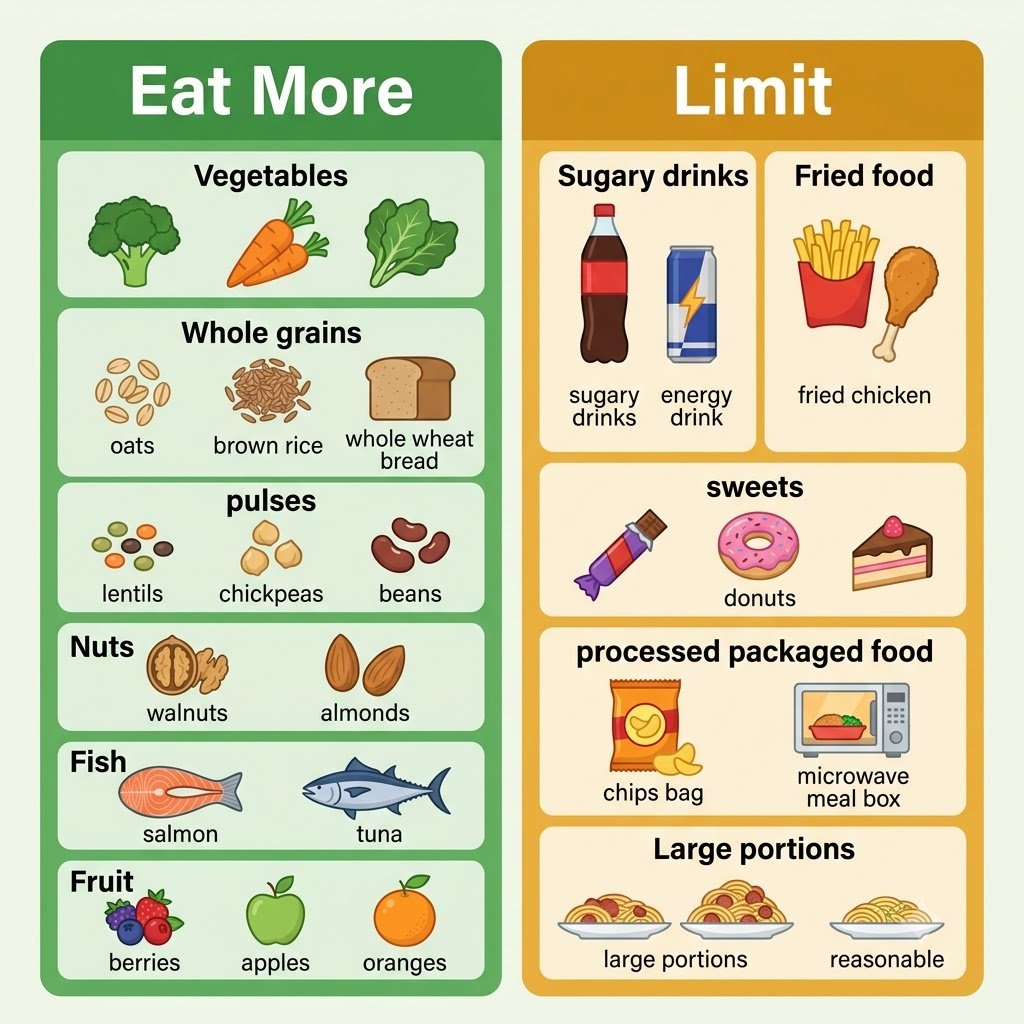
There is no single diet that suits everyone with fatty liver.
The general goal is to improve overall diet quality and, where appropriate, achieve gradual and sustainable weight management.
Useful food choices can include:
- Vegetables
- Whole grains
- Pulses and legumes
- Fruit in appropriate portions
- Nuts and seeds
- Fish
- Lean protein
- Foods containing unsaturated fats
Foods to Limit
Depending on your individual health needs, consider limiting:
- Sugary drinks
- Excess added sugar
- Highly processed foods
- Deep-fried foods
- Foods high in trans fats
- Excess saturated fat
- Excess refined carbohydrates
- Very large portion sizes
If you have diabetes, kidney disease or another medical condition, your diet may need further adjustment under medical guidance.
Can Exercise Help Fatty Liver?
Regular physical activity can improve metabolic health and may benefit people with fatty liver — sometimes even when significant weight loss does not occur.
Activities can include:
- Walking
- Cycling
- Swimming
- Strength training
- Other moderate activities you can safely perform
If you have not exercised regularly, start gradually. People with significant medical conditions should discuss an appropriate exercise programme with their healthcare professional.
What Should You Avoid With Fatty Liver?
There is no universal list of foods that every person with fatty liver must completely avoid.
However, reducing excessive intake of sugary drinks, added sugars, deep-fried foods, highly processed foods, excess calories and foods high in saturated or trans fats may support healthier metabolic habits.
Alcohol can also contribute to liver injury, so discuss alcohol consumption with your healthcare professional.
⚠️ Be Careful With “Liver Detox” Products
There is no need to rely on “detox” drinks or unproven supplements to treat fatty liver.
Some supplements and herbal products can themselves affect the liver. Always tell your doctor about any supplements you are taking.
Can Fatty Liver Be Treated With Medicine?
Treatment depends on:
- The cause of fatty liver
- Degree of liver injury
- Fibrosis risk
- Body weight
- Diabetes
- Cholesterol
- Other medical conditions
Lifestyle management remains important in almost all cases. Some people may also need treatment for associated conditions such as diabetes, high cholesterol, high blood pressure or obesity.
Do not start or stop any medication based on an online article.
Fatty Liver and Alcohol
Alcohol can contribute to fatty liver and liver injury.
If you have been diagnosed with fatty liver, discuss alcohol use with your doctor. The appropriate advice depends on the cause and severity of the liver condition.
What Tests May Be Needed for Fatty Liver?
| Test | Why It May Be Used |
|---|---|
| LFT | Assess liver-related blood markers |
| ALT / SGPT | Liver enzyme |
| AST / SGOT | Liver enzyme |
| Bilirubin | Assess bilirubin-related abnormalities |
| CBC | Includes platelet count and other blood-cell information |
| Lipid Profile | Assess cholesterol and triglycerides |
| Fasting Blood Glucose | Assess blood glucose |
| HbA1c | Assess average blood glucose |
| Ultrasound | Look for liver fat |
| FibroScan | Assess liver stiffness / fibrosis risk |
| FIB-4 | Non-invasive fibrosis risk assessment |
Not everyone needs every test. Your healthcare professional should decide which investigations are appropriate for you.
When Should You See a Doctor?
Speak with a healthcare professional if:
- An ultrasound shows fatty liver
- Your liver enzymes are repeatedly abnormal
- You have diabetes
- You have obesity or other metabolic risk factors
- You have high triglycerides
- You have persistent upper-right abdominal discomfort
- You have unexplained fatigue
- You have abnormal liver-test results
Seek urgent medical attention for:
- Yellowing of the skin or eyes
- Severe abdominal swelling
- Vomiting blood
- Black or tarry stools
- Significant confusion
- Rapid deterioration in health
What Should You Do After a Fatty Liver Diagnosis?
If your ultrasound report says “fatty liver”, don’t panic. Work through it step by step.
Step 1 — Understand the report. Check exactly what the ultrasound says, and whether it mentions Grade 1, Grade 2, Grade 3 or any other abnormality.
Step 2 — Review your metabolic health. Discuss blood glucose, HbA1c, cholesterol, triglycerides, blood pressure and weight.
Step 3 — Check liver-related blood tests. Your doctor may recommend an LFT or other blood tests.
Step 4 — Assess fibrosis risk when appropriate. Depending on your risk, your doctor may consider FIB-4, FibroScan or another assessment.
Step 5 — Improve long-term habits. Focus on sustainable improvements in diet, physical activity, weight management, diabetes control and cholesterol management.
Frequently Asked Questions
1. What is fatty liver? Fatty liver means excess fat has accumulated in the liver. The medical term is hepatic steatosis.
2. What are the symptoms of fatty liver? Many people have no symptoms. Some may experience fatigue or mild discomfort in the upper-right abdomen.
3. Is Grade 1 fatty liver serious? Grade 1 usually describes mild fatty accumulation on imaging. It does not automatically mean advanced liver disease, but the underlying metabolic risk factors should be assessed.
4. Can Grade 1 fatty liver improve? Yes. Liver fat can decrease in many people when appropriate lifestyle and metabolic-risk management are followed.
5. Does fatty liver cause pain? Some people report mild discomfort in the upper-right abdomen, but significant pain is not typical of uncomplicated fatty liver and should be evaluated.
6. Can fatty liver be detected through a blood test? Blood tests give information about liver enzymes and metabolic health, but they cannot by themselves determine the full extent of fatty liver.
7. Can ultrasound detect fatty liver? Yes. Ultrasound can detect liver fat, although it has limitations and does not reliably measure liver fibrosis.
8. Is an LFT enough to detect fatty liver? No. An LFT provides useful information about liver-related blood markers, but a normal LFT does not rule out fatty liver.
9. Is FibroScan the same as ultrasound? No. FibroScan uses transient elastography to assess liver stiffness and gives additional information about fibrosis risk.
10. What foods should I avoid with fatty liver? Limit sugary drinks, highly processed foods, deep-fried foods, added sugars and foods high in saturated or trans fats.
11. Can walking help fatty liver? Regular physical activity can improve metabolic health and may benefit fatty liver, even when substantial weight loss does not occur.
12. Does fatty liver mean cirrhosis? No. Some people have liver fat without advanced fibrosis, while others may develop progressive liver injury over time.
13. Can fatty liver come back? Yes. If the underlying metabolic or lifestyle risk factors return, liver fat can increase again.
14. Should everyone with Grade 1 fatty liver get a FibroScan? Not necessarily. Whether FibroScan or another fibrosis assessment is appropriate depends on your individual risk and should be decided with a healthcare professional.
Final Takeaway
Fatty liver is common and often causes no obvious symptoms. The ultrasound grade is only one part of the picture.
If you have fatty liver, it is worth looking at your liver enzymes, blood sugar, HbA1c, cholesterol, triglycerides, blood pressure, weight, overall metabolic health and — where appropriate — your fibrosis risk.
For many people, improving diet, increasing physical activity and managing metabolic risk factors can help reduce liver fat and support long-term liver health.
The goal is not simply to “treat Grade 1”. The goal is to understand why the liver has accumulated fat, and whether there is any evidence of liver injury or fibrosis.
🔗 Related Reading
- Liver Function Test (LFT): SGPT & SGOT Normal Range
- How to Read Your Lipid Profile Report: Complete Guide
- HbA1c Test: Normal Range, Prediabetes & Diabetes Levels
- Normal Blood Sugar Level Chart: Fasting, Post-Meal & HbA1c
- What Is Diabetes? Symptoms, Causes & Early Diagnosis
- Kidney Function Test (KFT): Normal Range & How to Read Your Report
📚 External References
(Please open and confirm each link before publishing — organisations occasionally restructure their pages.)
- National Institute of Diabetes and Digestive and Kidney Diseases (NIDDK), USA — Nonalcoholic Fatty Liver Disease & NASH — https://www.niddk.nih.gov/health-information/liver-disease/nafld-nash
- NHS UK — Non-alcoholic fatty liver disease (NAFLD) — https://www.nhs.uk/conditions/non-alcoholic-fatty-liver-disease/
- World Health Organization — Obesity and overweight — https://www.who.int/news-room/fact-sheets/detail/obesity-and-overweight
- MedlinePlus (US National Library of Medicine) — Liver Function Tests — https://medlineplus.gov/lab-tests/liver-function-tests/
- American Association for the Study of Liver Diseases (AASLD) — https://www.aasld.org
⚕️ Medical Disclaimer
This article is provided for general educational and informational purposes only. It is not a substitute for professional medical advice, diagnosis or treatment.
Fatty liver can have different causes and levels of severity. Ultrasound findings, blood tests and risk scores should be interpreted in the context of your medical history and clinical assessment.
Do not start, stop or change medicines or supplements based only on this article.
If you have abnormal liver-test results, an abnormal ultrasound or symptoms of possible liver disease, consult a qualified healthcare professional.
HealthPartner India is a healthcare assistance and information platform. We help customers access and book diagnostic tests through our partner network, but we do not provide medical diagnosis or treatment.
🧪 Need Help Booking Your Tests?
HealthPartner India can help you check current availability and pricing for diagnostic tests through our partner network.
We can help you check tests such as:
- Liver Function Test (LFT)
- Lipid Profile
- HbA1c
- Blood Sugar Tests
- Full-Body Health Checkup Packages
- Other available diagnostic tests
📱 WhatsApp: +91 93479 68950
HealthPartner India can help you enquire about booking options through Tata 1mg where offered. Pricing, availability, home collection and fulfilment depend on your location and the provider.