
Quick Summary
- A CBC (Complete Blood Count) is a common blood test that measures red blood cells, white blood cells, platelets, haemoglobin and other blood-related measurements.
- CBC is also called a complete blood count, full blood count or haemogram test.
- CBC testing can help doctors investigate anaemia, infections, blood-cell abnormalities and other health conditions.
- A CBC report contains several values including Hb, RBC, WBC, platelets, haematocrit, MCV, MCH and MCHC.
- Normal ranges vary by laboratory, age, sex and other factors. Always compare your result with the reference range printed on your own report.
- A CBC result outside the laboratory range does not automatically mean that you have a disease. Your doctor interprets the result along with your symptoms, medical history and other tests.
What Is a CBC Test?
A CBC test (Complete Blood Count) is a blood test that measures the number and characteristics of different blood cells.
A CBC commonly includes:
- Red blood cell (RBC) count
- White blood cell (WBC) count
- Platelet count
- Haemoglobin (Hb)
- Haematocrit (HCT or PCV)
- Mean corpuscular volume (MCV)
Depending on the laboratory, a CBC may also report additional red blood cell indices and a white blood cell differential.
A CBC with differential provides information about different types of white blood cells, including neutrophils, lymphocytes, monocytes, eosinophils and basophils.
CBC Full Form
CBC full form: Complete Blood Count.
It is also commonly called:
- CBC blood test
- Complete blood count test
- Full blood count
- Haemogram
- Haemogram test
- Blood count test
Why Do Doctors Order a CBC Test?
A doctor may recommend a CBC test as part of a routine health checkup or when investigating symptoms.
Common reasons include:
- Checking for anaemia
- Investigating fatigue or weakness
- Evaluating certain infections
- Investigating unexplained fever
- Checking unusual bruising or bleeding
- Monitoring an existing blood condition
- Monitoring the effect of certain medicines or treatments
- Evaluating changes in blood-cell counts
- Supporting the investigation of some immune-system or blood disorders
- Routine or pre-employment health testing
A CBC is only one part of a medical evaluation. An abnormal result does not by itself establish a diagnosis.
CBC Test Normal Range Chart
Reference ranges differ between laboratories. The following are general adult reference ranges and should not replace the reference range printed on your laboratory report.
| CBC Parameter | General Adult Range |
|---|---|
| Haemoglobin (Hb) | Men: about 13.5–17.5 g/dL; Women: about 12.0–15.5 g/dL |
| RBC Count | Men: about 4.6–6.2 million/µL; Women: about 4.2–5.4 million/µL |
| WBC Count | About 4,500–11,000 cells/µL |
| Platelet Count | About 150,000–400,000/µL |
| Haematocrit (HCT/PCV) | Men: about 40–52%; Women: about 37–48% |
| MCV | About 80–100 fL |
| MCH | About 27–32 pg/cell |
| MCHC | About 32–36 g/dL |
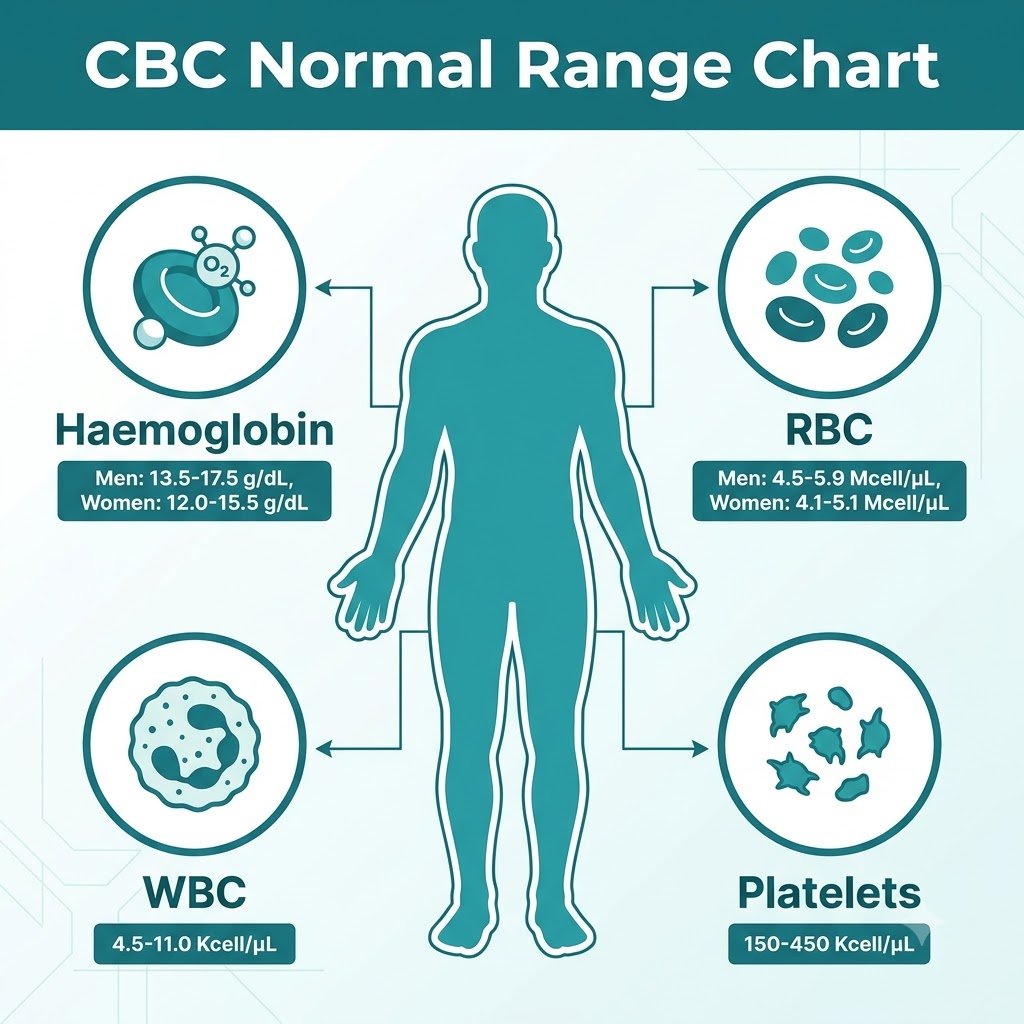
Note: these figures are standardized to a single commonly-cited reference source across all HealthPartner India lab-test guides, so numbers stay consistent between articles. Laboratory reference intervals can still differ from lab to lab — always use the range printed on your own CBC report.
How to Read a CBC Report
A CBC blood report can look confusing because it contains many abbreviations.
Here are the most important CBC parameters.
1. Haemoglobin (Hb)
Haemoglobin is the oxygen-carrying protein in red blood cells.
A low haemoglobin level can occur with anaemia and may be associated with iron deficiency, vitamin B12 deficiency, blood loss and other conditions.
A high haemoglobin result can occur for several reasons, including dehydration, smoking, living at high altitude and certain medical conditions.
2. RBC Count
RBC means red blood cell count.
Red blood cells carry oxygen from the lungs to tissues throughout the body.
A low RBC count may occur with anaemia or other conditions.
A high RBC count may occur with dehydration, smoking, prolonged low oxygen levels or certain blood disorders.
3. WBC Count
WBC means white blood cell count.
White blood cells are involved in the body’s immune response.
A high WBC count may occur with infections, inflammation, physical stress, certain medicines and some blood disorders.
A low WBC count may occur with some viral infections, autoimmune conditions, bone marrow disorders, certain medicines and other conditions.
4. Platelet Count
Platelets help the blood form clots.
A low platelet count is called thrombocytopenia.
A high platelet count is called thrombocytosis.
Platelet abnormalities can have many causes, so the result should be interpreted with the rest of the CBC and your clinical history.
5. Haematocrit / PCV
Haematocrit measures the proportion of your blood made up of red blood cells.
A low haematocrit can occur with anaemia.
A high haematocrit can occur with dehydration, prolonged low oxygen levels and certain medical conditions.
6. MCV
MCV stands for Mean Corpuscular Volume.
It indicates the average size of your red blood cells.
MCV is particularly useful when doctors are investigating different types of anaemia.
- Low MCV = smaller-than-usual red blood cells
- Normal MCV = average-sized red blood cells
- High MCV = larger-than-usual red blood cells
7. MCH
MCH stands for Mean Corpuscular Haemoglobin.
It describes the average amount of haemoglobin contained in an individual red blood cell.
8. MCHC
MCHC stands for Mean Corpuscular Haemoglobin Concentration.
It indicates the concentration of haemoglobin inside red blood cells.
9. RDW
RDW stands for Red Cell Distribution Width.
It describes variation in the size of red blood cells.
Doctors may use RDW together with Hb, MCV and other CBC parameters when investigating anaemia.
CBC Differential Count
A CBC with differential provides information about different types of white blood cells.
These include:
| White Blood Cell | Main Role |
|---|---|
| Neutrophils | Important part of the body’s defence against infections |
| Lymphocytes | Important for immune responses |
| Monocytes | Help remove germs and damaged cells |
| Eosinophils | Involved in allergies, parasites and inflammation |
| Basophils | Involved in allergic and inflammatory responses |
A differential count may help doctors understand patterns in infections, immune conditions and other illnesses.
CBC Report Example: How to Understand Your Results
Suppose your CBC report contains:
Hb: 10.5 g/dL WBC: 8,000/µL Platelets: 2.2 lakh/µL MCV: 75 fL
You should not diagnose yourself from these values alone.
Instead, compare each value with the laboratory’s reference range and discuss the overall pattern with your doctor.
For example, a low haemoglobin together with a low MCV may lead a doctor to investigate causes of microcytic anaemia, including iron deficiency.
The interpretation depends on your age, sex, symptoms, medical history and other test results.
What Does a High CBC Result Mean?
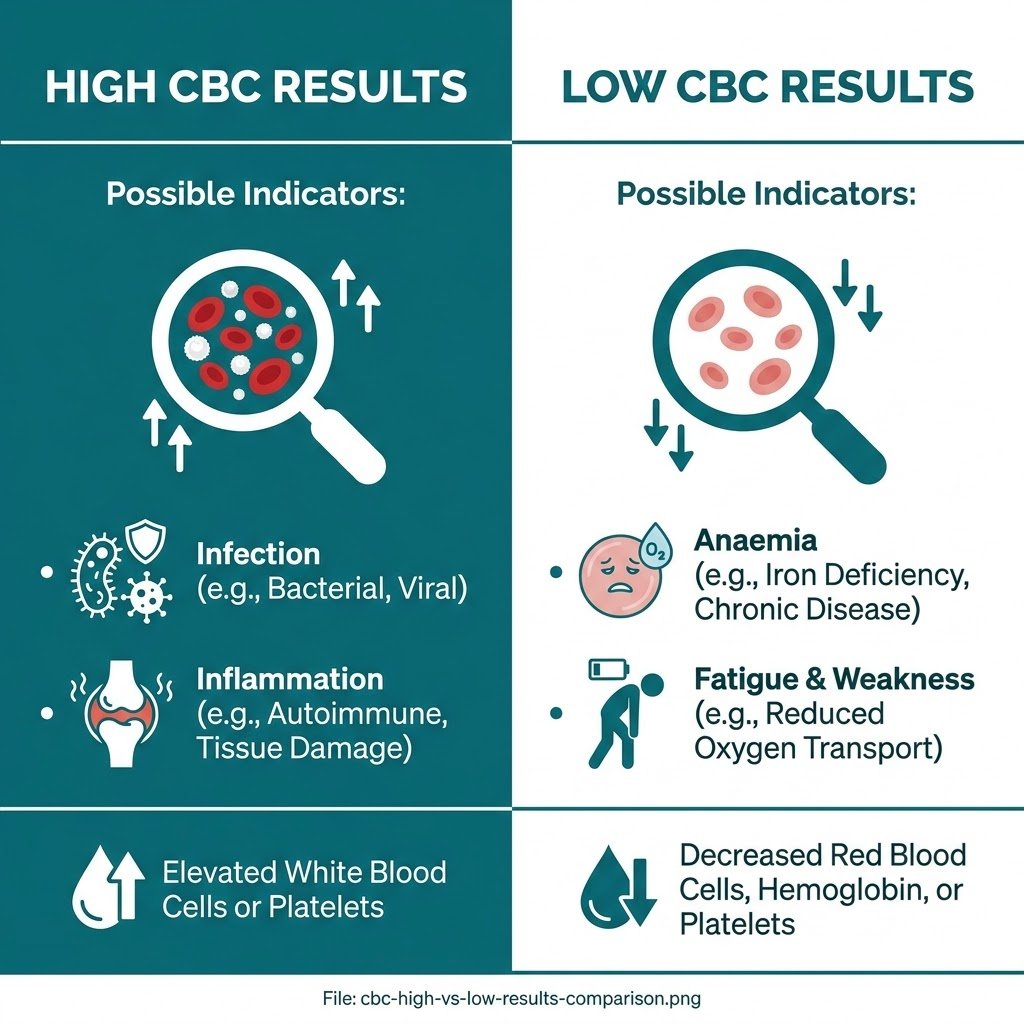
There is no single “high CBC” result because a CBC contains many different measurements.
For example:
High WBC
May occur with:
- Infection
- Inflammation
- Physical stress
- Certain medicines
- Some blood disorders
High RBC or Haemoglobin
May occur with:
- Dehydration
- Smoking
- Living at high altitude
- Prolonged low oxygen levels
- Certain medical conditions
High Platelets
May occur with:
- Inflammation
- Iron deficiency
- Recovery after blood loss
- Some bone marrow disorders
The cause cannot be determined from the number alone.
What Does a Low CBC Result Mean?
Again, the meaning depends on which CBC parameter is low.
Low Haemoglobin
May indicate anaemia.
Common causes include:
- Iron deficiency
- Vitamin B12 deficiency
- Folate deficiency
- Blood loss
- Chronic diseases
- Other medical conditions
See our guides:
Iron Deficiency Symptoms, Causes & Tests
Vitamin B12 Deficiency Symptoms & Causes
Low WBC
Possible causes include:
- Some viral infections
- Certain medicines
- Autoimmune conditions
- Bone marrow disorders
- Other medical conditions
Low Platelets
Possible causes include:
- Certain infections
- Immune conditions
- Medicines
- Bone marrow disorders
- Other medical conditions
A low platelet count can sometimes require prompt medical assessment, particularly when accompanied by unusual bleeding or bruising.
Can a CBC Test Detect Infection?
A CBC can provide clues that may support the evaluation of an infection.
For example, changes in WBC count or differential count may occur during infections.
However, a CBC alone cannot always identify whether an infection is present, what caused it or where it is located.
Doctors interpret CBC findings together with symptoms, examination and sometimes other tests such as CRP or ESR.
Can a CBC Test Detect Cancer?
A CBC cannot diagnose cancer by itself.
However, certain abnormal blood-cell patterns may lead a doctor to investigate further.
Additional tests may be required depending on the clinical situation.
CBC vs CRP vs ESR
CBC, CRP and ESR provide different types of information.
| Test | What It Mainly Measures | Common Use |
|---|---|---|
| CBC | Blood cells, haemoglobin and related measurements | Anaemia, infection evaluation, blood-cell abnormalities |
| CRP | C-reactive protein associated with inflammation | Inflammation and infection evaluation |
| ESR | Rate at which red blood cells settle | Evaluation and monitoring of inflammation |
Read more:
CRP Test: Normal Range & What High CRP Means
ESR Test: Normal Range, High ESR Causes & Meaning
Symptoms That May Lead to a CBC Test
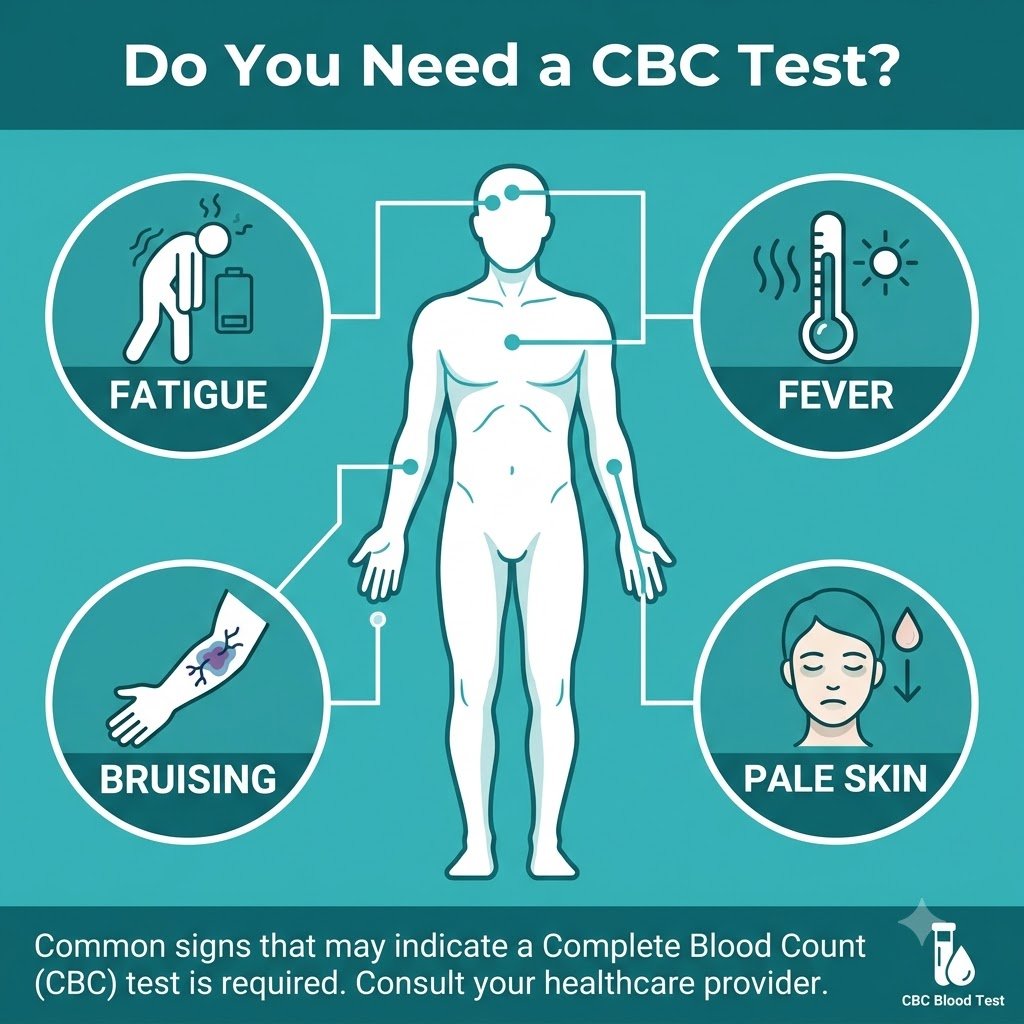
A doctor may consider a CBC when symptoms include:
- Persistent fatigue
- Weakness
- Unexplained fever
- Frequent infections
- Pale skin
- Dizziness
- Shortness of breath
- Unusual bruising
- Unusual bleeding
- Unexplained weight loss
These symptoms can have many causes and do not automatically mean a CBC is required.
How Is a CBC Test Done?
A CBC requires a small blood sample, usually taken from a vein in your arm.
The blood sample is sent to a laboratory for analysis.
The actual blood collection generally takes only a few minutes.
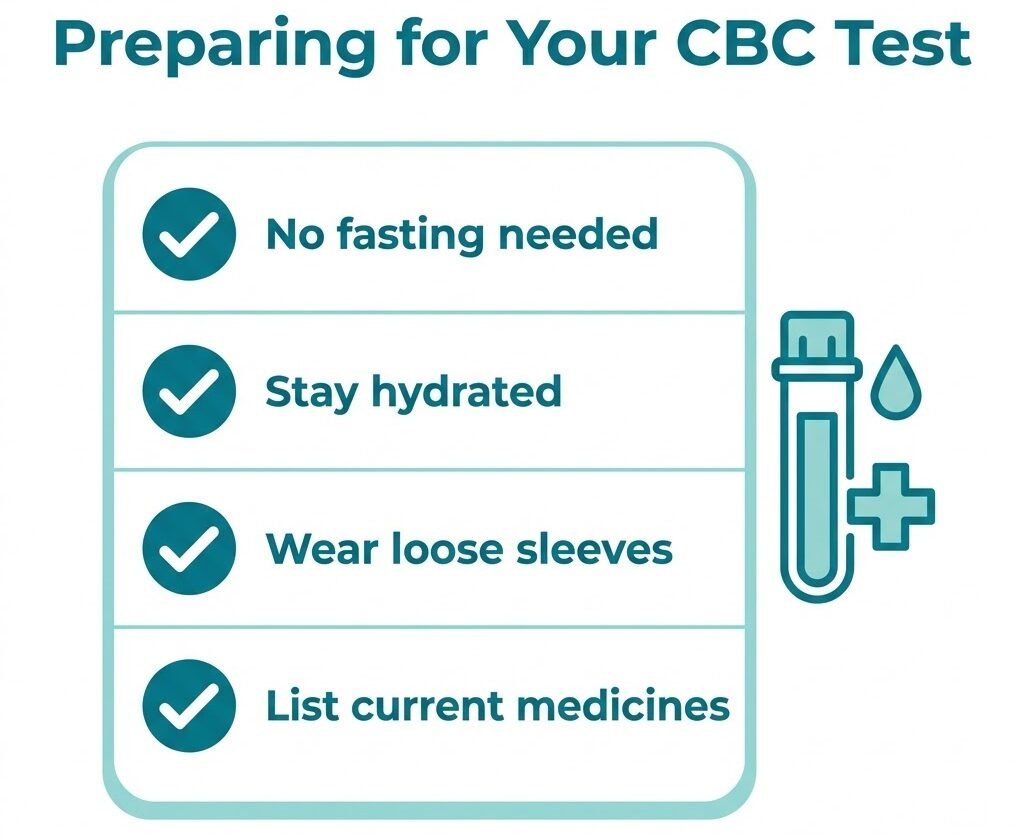
Is Fasting Required for a CBC Test?
Usually, fasting is not required for a CBC test alone.
However, if your doctor orders other blood tests at the same time, such as fasting blood glucose or a lipid profile, you may need to follow fasting instructions.
Always follow the instructions given by your doctor or laboratory.
CBC Test Cost in India
The price of a CBC blood test varies depending on the laboratory, city, location and whether home sample collection is included.
A standalone CBC test may commonly fall around ₹200–₹500, but prices can change.
Always check the current price before booking.
When Should You Take a CBC Test?
A doctor may recommend a CBC when investigating symptoms such as fatigue, fever, weakness, unusual bruising or other concerns.
It may also be included in routine health checkups or used to monitor an existing medical condition.
There is no single testing schedule that is appropriate for every healthy adult. Your doctor can advise whether and how often you need a CBC based on your individual situation.
Compare CBC Test Prices & Get Booking Assistance
CBC test prices can vary between laboratories and locations.
Health Partner India, in partnership with Tata 1mg and Torus Health, can help you check available diagnostic test options and get assistance with booking.
👉 Chat with us on WhatsApp for current CBC test prices and availability.
Frequently Asked Questions
1. What is the CBC test?
CBC stands for Complete Blood Count. It measures important blood components including red blood cells, white blood cells, platelets, haemoglobin and haematocrit.
2. What is the normal CBC range?
There is no single normal CBC number because CBC contains multiple parameters. Each parameter has its own reference range, and the range may differ between laboratories.
3. How do I read a CBC blood report?
Start by comparing Hb, RBC, WBC, platelets, haematocrit and MCV with the reference ranges printed on your report. Then discuss abnormal or unexpected results with your doctor.
4. Is fasting required for a CBC test?
Usually no. Fasting may be required if other fasting blood tests are ordered at the same time.
5. What does low haemoglobin mean?
Low haemoglobin can indicate anaemia. Iron deficiency, vitamin B12 deficiency, blood loss and other conditions can cause low haemoglobin.
6. What does high WBC mean?
High WBC can occur with infections, inflammation, physical stress, certain medicines and some blood disorders.
7. What does low platelet count mean?
Low platelets can have several causes, including infections, immune conditions, medicines and bone marrow disorders. Your doctor should interpret the result based on your overall health.
8. Can CBC detect cancer?
CBC cannot diagnose cancer by itself. Some abnormal blood-count patterns may lead to additional investigations.
9. What is CBC with differential?
CBC with differential provides information about the different types of white blood cells, including neutrophils, lymphocytes, monocytes, eosinophils and basophils.
10. How much does a CBC test cost in India?
A standalone CBC test may commonly cost around ₹200–₹500, but prices vary by laboratory and location.
Medical References
- MedlinePlus — Complete Blood Count (CBC)
- MedlinePlus — CBC Blood Test
- MedlinePlus — Blood Differential
This article is for informational purposes only and does not replace advice from a qualified healthcare provider. Always discuss your test results with your doctor.
📲 Follow Health Partner India for health information: