
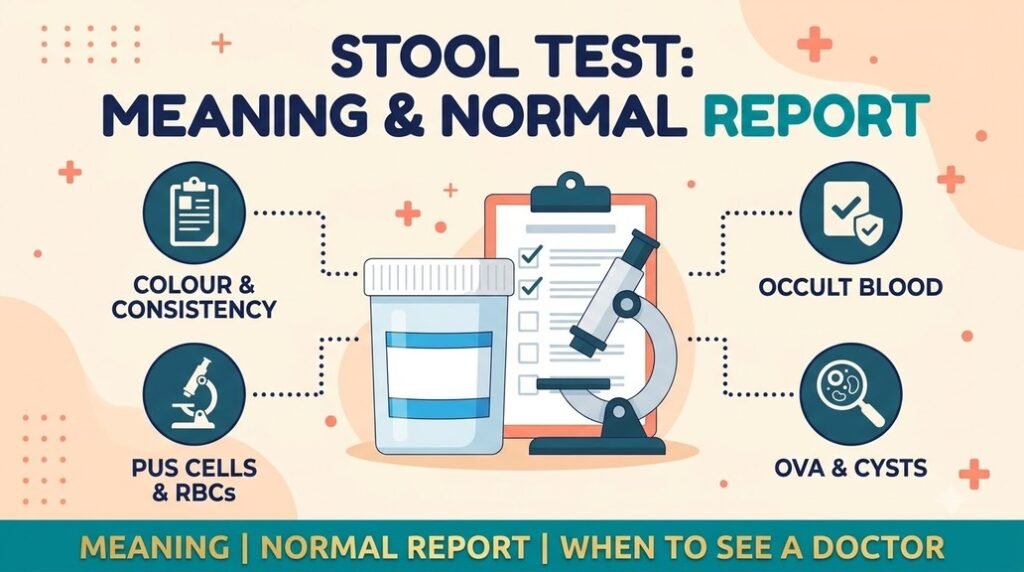
Quick answer: A stool test, most commonly the stool routine test (also called stool R/E, stool RM or stool routine microscopy), examines a stool sample for its appearance, chemical findings and microscopic contents, such as pus cells, red blood cells, parasite eggs and cysts. It may help doctors investigate diarrhoea, abdominal pain, blood or mucus in stool and suspected intestinal infections. An abnormal result does not automatically confirm a disease, and a normal result does not rule out every digestive problem.
Who this guide is for: This guide is for people who have been advised to take a stool test, or who want to understand a stool test report. It provides general educational information. Use it to prepare questions for your doctor, not to diagnose an infection, choose treatment or start medicines yourself.
Key Takeaways
- A stool routine test is also called stool R/E, stool RM or stool routine microscopy.
- The test may include physical, chemical and microscopic examinations.
- Common findings include colour, consistency, mucus, occult blood, pus cells, red blood cells, ova and cysts.
- Normal findings and reference ranges vary between laboratories.
- Stool culture, occult blood testing and ova and parasite testing are separate tests that answer different questions.
- Correct sample collection is important for reliable results.
- Black or tarry stools, heavy bleeding, bloody diarrhoea, severe abdominal pain or signs of dehydration need prompt medical assessment.
Last updated: 27 October 2026.
What Is a Stool Routine Test?
A stool routine test is a laboratory examination of a small stool sample. It is also known as stool routine examination (R/E), stool routine and microscopy (RM), stool analysis or stool examination.
The test helps a doctor look for findings that may be associated with digestive problems, intestinal infections or bleeding.
A routine stool examination generally involves three types of assessment.
1. Physical Examination
The laboratory may examine:
- Colour
- Consistency
- Visible mucus
- Visible blood
- Other noticeable characteristics
2. Chemical Examination
Depending on the laboratory and test ordered, the report may include:
- Occult blood, which means hidden blood
- Reaction or pH
- Reducing substances in selected cases
3. Microscopic Examination
A laboratory professional may examine the sample for:
- Pus cells or white blood cells
- Red blood cells
- Ova, meaning parasite eggs
- Cysts of certain parasites
- Yeast cells
- Undigested food particles
- Fat globules
Not every laboratory includes every parameter in a routine stool test. The exact findings depend on the test requested and the laboratory’s procedure.
A stool test report should always be read alongside symptoms, medical history and other investigations when needed.
What Is a Stool Test Used For?
People often search “stool test for what” because they want to understand why a doctor has recommended it. A stool test may be requested for several reasons.
Diarrhoea
Persistent or severe diarrhoea can have several causes, including infections and other digestive conditions. Depending on the symptoms, a doctor may request a routine stool examination, a stool culture or another specialised test.
Abdominal Pain and Digestive Discomfort
Stomach pain, cramps, bloating and gas can occur for many reasons. A stool test may provide useful information when an intestinal problem is suspected, but it cannot identify every cause of abdominal discomfort.
Blood or Mucus in Stool
Visible blood, mucus or a positive occult blood result may need further investigation. The next step depends on the amount of bleeding, other symptoms, medical history and the type of test performed.
Suspected Intestinal Parasites
An ova and parasite test looks for certain parasites and their eggs in a stool sample. A routine microscopic examination may also report parasite-related findings, depending on its scope.
A negative result does not always exclude a parasitic infection. Additional samples or other tests may be needed.
Unexplained Anaemia
Blood loss from the digestive tract is one possible cause of anaemia. A doctor may recommend an occult blood test or other investigations when appropriate. If you are also reviewing blood counts, our guide to the complete blood count (CBC) test explains what that separate test measures.
Follow-Up Testing
In selected cases, doctors may request another stool sample after treatment or when symptoms continue. The need for repeat testing depends on the suspected condition and the test used.
What Is the Normal Stool Test Report?
There is no single reference range that applies to every stool test or laboratory. Reports use different terminology, and some parameters may not be included in a basic stool routine examination.
The table below is a general guide to findings commonly reported in routine stool examinations. It does not replace the reference ranges printed on your report.
| Parameter | Commonly reported finding | What an abnormal finding may indicate |
|---|---|---|
| Colour | Brown | Diet, medicines or medical causes may explain unusual colours |
| Consistency | Formed or semi-formed | Loose or watery stool may occur with diarrhoea and other digestive problems |
| Mucus | Absent or minimal | Increased mucus may occur with intestinal irritation or inflammation |
| Visible blood | Absent | Bleeding needs appropriate medical assessment |
| Occult blood | Negative, when tested | A positive result means the test detected blood |
| Reaction or pH | Depends on the laboratory | Interpreted with other findings and the clinical situation |
| Reducing substances | Negative or not detected, when tested | May need assessment in selected infants or children |
| Pus cells | None or few, depending on the laboratory | Increased numbers may be associated with infection or inflammation |
| Red blood cells | Not seen | May indicate bleeding or another cause that needs assessment |
| Ova and cysts | Not seen | Reported parasites or their eggs need clinical interpretation |
| Undigested food | Small amounts may be present | Significance depends on the amount, symptoms and other findings |
| Fat globules | Depends on the method and reference range | Increased fat may prompt assessment for digestion or absorption problems |
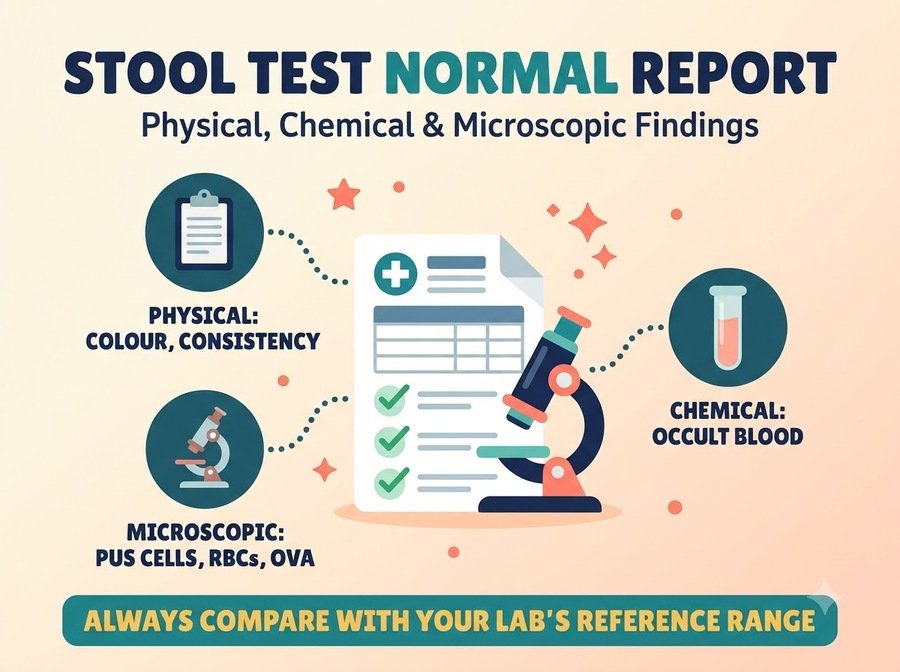
Important: A finding outside the laboratory’s reference range does not necessarily mean a serious disease is present. Likewise, a report marked “normal” does not exclude every condition. If your report contains unfamiliar terms, ask your doctor or laboratory professional to explain them.
What Do Abnormal Stool Test Results Mean?
An abnormal stool test result means that one or more findings differ from what the laboratory expects. It does not necessarily identify the exact cause.
Pus Cells in Stool
Pus cells are white blood cells. Increased numbers may occur with intestinal infection or inflammation. However, pus cells alone cannot show which organism or condition is responsible. Your doctor may consider how long you have had symptoms, fever, blood in stool and other findings before deciding whether more tests are needed.
Mucus in Stool
Mucus is produced naturally by the digestive tract. An increase in visible mucus may occur in several digestive conditions. The importance of this finding depends on whether you also have diarrhoea, abdominal pain, bleeding, fever or persistent changes in bowel habits.
Red Blood Cells in Stool
Red blood cells reported during microscopic examination may indicate bleeding somewhere in the digestive tract or another source of blood contamination. The result needs clinical interpretation. Seek medical advice if blood is repeatedly seen in your stool or appears with other symptoms.
Positive Occult Blood
Occult blood is blood that cannot be seen with the naked eye.
A positive stool occult blood test means the test detected blood. According to MedlinePlus, this suggests bleeding somewhere in the digestive tract, but not necessarily cancer. Haemorrhoids, ulcers, polyps and other gastrointestinal conditions can also cause it. Your doctor may recommend further assessment, often including a colonoscopy, depending on the test type and your circumstances.
Reference: MedlinePlus: Fecal Occult Blood Test
Ova, Cysts or Parasites
If parasite eggs or cysts are identified, the doctor will interpret the result and decide whether treatment or additional investigation is needed. Some parasites may not appear in every sample, so repeat samples or a different test may be recommended when suspicion remains.
Reference: MedlinePlus: Ova and Parasite Test
Reducing Substances
Reducing substances may be measured in selected cases, including some evaluations of infants and young children with diarrhoea. This result must be interpreted by a qualified healthcare professional in the context of the child’s symptoms and other findings.
Undigested Food and Fat Globules
Small amounts of undigested food may appear in stool. Larger amounts of fat may prompt further assessment when they come with symptoms such as persistent diarrhoea, greasy stools or unexplained weight loss. Neither finding establishes a diagnosis on its own.
Stool Routine Test vs Other Stool Tests
The term “stool test” covers several different laboratory investigations. These tests are not interchangeable.
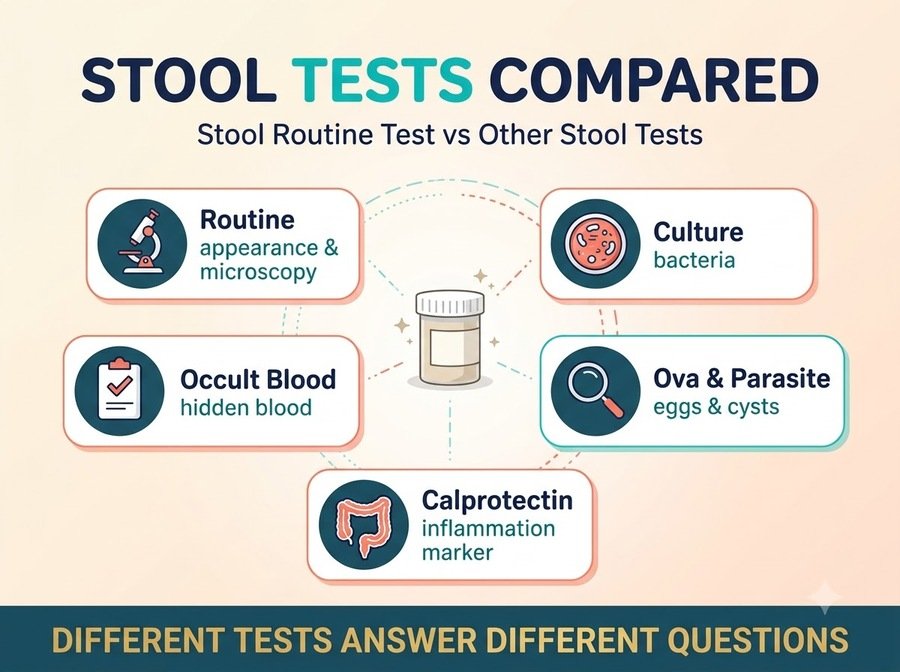
Stool Routine Test
A routine stool examination assesses the sample’s appearance and, depending on the test, its chemical and microscopic characteristics. It may provide useful initial information about digestive symptoms.
Stool Culture and Sensitivity
A stool culture attempts to grow bacteria from a sample when a bacterial intestinal infection is suspected. If a relevant organism is identified, further testing may help show which antibiotics are likely to be effective. Not every intestinal infection needs a culture or antibiotic treatment.
Stool Occult Blood Test
A fecal occult blood test checks for hidden blood in stool. Two commonly used methods are the guaiac-based test (gFOBT) and the fecal immunochemical test (FIT). MedlinePlus notes that FIT is better at detecting blood than gFOBT.
These tests may be used in colorectal cancer screening or in the investigation of suspected gastrointestinal bleeding. They cannot diagnose cancer by themselves.
Ova and Parasite Test
An ova and parasite (O&P) test looks for certain intestinal parasites and their eggs. A doctor may request several samples collected on different days, because parasites are not necessarily present in every sample.
Stool H. pylori Antigen Test
This test looks for evidence of Helicobacter pylori, a bacterium associated with stomach inflammation and peptic ulcers. It is a specific test and is different from a routine stool examination. Some medicines can affect the result, so follow the instructions from your doctor or laboratory. You can read more in our guide to the H. pylori test: stool antigen, breath test, results and preparation.
Fecal Calprotectin Test
Fecal calprotectin measures a marker associated with inflammation in the intestines. It may help doctors assess ongoing digestive symptoms and tell some inflammatory conditions from non-inflammatory causes. It does not establish a specific diagnosis by itself.
Can a Stool Test Detect Colon Cancer?
A routine stool examination cannot diagnose colon cancer.
Specific stool screening tests, such as FIT and gFOBT, look for hidden blood that may come from several causes, including polyps, haemorrhoids, ulcers or colorectal cancer. A positive screening result usually needs follow-up assessment. A negative result does not rule out every colorectal condition.
If you have persistent blood in your stool, a sustained change in bowel habits, unexplained weight loss or unusual tiredness, consult a doctor rather than relying on a stool test alone. The appropriate screening schedule depends on factors such as age, family history, personal medical history and local clinical guidance.
Reference: MedlinePlus: Colorectal Cancer Screening Tests
Can a Stool Test Check Gut Health?
A routine stool test provides limited information about digestive health. It may identify findings such as blood, mucus, pus cells or parasite eggs, but it does not give a complete assessment of digestion or of the microorganisms that live in the intestines.
Commercial gut microbiome tests are different from routine stool examinations. Their results should not be used alone to diagnose a medical condition or to change prescribed treatment.
How to Collect a Stool Sample Correctly
Correct sample collection matters because contamination or improper handling may affect the result.
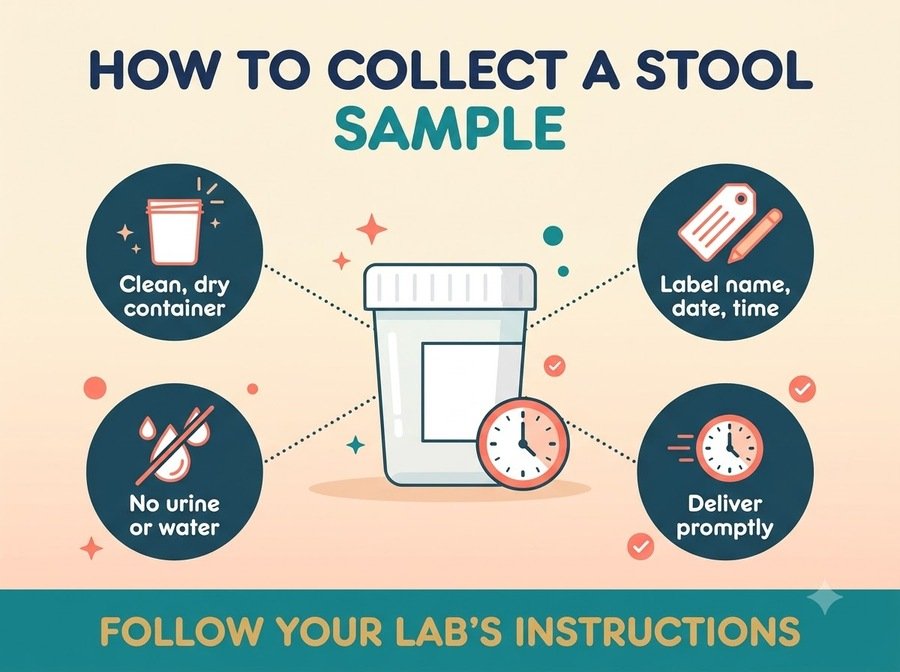
Follow the instructions supplied by your laboratory. General steps include:
- Prepare the container: Use the clean, dry, leak-proof container supplied by the laboratory.
- Collect the sample: Pass stool into a clean, dry collection vessel, or use the collection method supplied with the kit.
- Avoid contamination: Keep urine, toilet water and toilet paper out of the sample.
- Transfer the sample: Use the supplied spoon or spatula and collect the amount the laboratory specifies.
- Close the container: Secure the lid tightly.
- Label the sample: Record your name and the collection date and time, as the laboratory instructs.
- Wash your hands: Clean your hands thoroughly with soap and water.
- Deliver the sample promptly: Follow the laboratory’s instructions for transport, storage and timing.
Do not collect the sample directly from toilet water unless the laboratory’s kit specifically provides an approved method.
Reference: MedlinePlus: Ova and Parasite Test
Is Fasting Required for a Stool Test?
Fasting is generally not required for a routine stool examination.
Some specialised tests have specific preparation requirements. For some guaiac-based occult blood tests, MedlinePlus notes that certain medicines (such as ibuprofen, naproxen and aspirin), vitamin C above 250 mg a day, red meat and some raw fruits and vegetables can affect the result, and your provider will say what to avoid and for how long. Follow the instructions for your exact test. Never stop a prescribed medicine, such as aspirin for heart disease, without consulting your doctor.
How Much Stool Is Needed?
Only a small amount is often needed, but the exact quantity depends on the test and the collection kit. Check the container instructions or ask the laboratory before collecting the sample.
How Many Stool Samples Are Required?
A routine stool examination may need one sample. Some ova and parasite tests and occult blood tests need samples from more than one bowel movement or on different days. Your doctor or laboratory will tell you how many samples are needed.
How Long Does a Stool Test Take?
Reporting time depends on the laboratory, the test method and the type of investigation. A routine stool examination may be reported sooner than a stool culture, which needs time for organisms to grow. Specialised tests may have different turnaround times. Confirm the expected reporting time with the laboratory performing the test.
Stool Test Cost in India
The stool test price in India varies with the type of test, city, laboratory, collection method and whether home sample collection is available.
A routine stool examination, stool culture, occult blood test, ova and parasite test, H. pylori antigen test and fecal calprotectin test are different investigations and may have different charges.
Before booking, confirm:
- The exact test name
- The current test price
- Whether home collection is available at your location
- Any additional collection charges
- Sample preparation and delivery requirements
- The expected reporting time
Do not assume that a routine stool test includes specialised tests. Confirm which investigations are included in the selected package or booking.
When Should You See a Doctor?
A stool test report should not replace medical assessment when symptoms are significant.
Seek Urgent Medical Attention If You Have
- Heavy or continuous rectal bleeding
- Black, tarry stool or dark-red stool
- Bloody diarrhoea
- Severe or worsening abdominal pain
- Signs of significant dehydration, such as very little urine, dizziness or marked weakness
- Diarrhoea with severe illness or a high fever
Babies, young children, older adults and people with weakened immune systems may need earlier assessment when diarrhoea or vomiting persists.
Arrange a Medical Appointment If You Have
- Blood in stool that persists or recurs, such as for about three weeks
- A sustained change in bowel habits
- Persistent abdominal pain
- Unexplained weight loss
- Unusual tiredness or possible anaemia
- Diarrhoea that continues for several days or keeps returning
- Blood in a child’s stool
A doctor can decide whether a stool test, blood test, imaging study or another investigation is appropriate.
Reference: NHS: Bleeding from the bottom (rectal bleeding)
Frequently Asked Questions About the Stool Test
1. What is a stool routine test?
A stool routine test examines a stool sample for its appearance and, depending on the laboratory method, chemical findings and microscopic contents. It may help investigate digestive symptoms but cannot diagnose every condition on its own.
2. What is a stool test used for?
A doctor may recommend stool testing for diarrhoea, suspected intestinal infection, possible parasites, blood or mucus in stool, or other digestive symptoms. The exact test depends on the suspected cause.
3. What is the normal stool test report?
Common findings may include brown, formed stool, no visible blood, negative occult blood when tested, and no ova or cysts detected. Expected findings vary by laboratory and test type, so compare with the range on your report.
4. What do pus cells in stool mean?
Increased pus cells may be associated with intestinal infection or inflammation. They do not identify the exact cause, so a doctor must interpret them with other findings.
5. What does a positive occult blood test mean?
It means the test detected hidden blood in the stool sample. Several conditions can cause this, and further assessment may be needed to find the source. It does not necessarily mean cancer.
6. Is fasting needed for a stool test?
Fasting is generally unnecessary for a routine stool examination. Some specialised tests have particular preparation instructions, so check with the laboratory.
7. How much stool is needed for testing?
A small quantity is often enough, but the amount varies by test. Follow the collection kit’s instructions.
8. How is a stool test performed?
You collect a stool sample in the approved container, avoid contamination, seal and label it as instructed, and deliver it to the laboratory according to its handling requirements.
9. Can a stool test detect worms?
An ova and parasite test can identify certain parasites or their eggs. A routine stool examination may also report parasite-related findings, depending on its scope. Additional samples may be needed.
10. Can a stool test detect colon cancer?
A routine stool test cannot diagnose colon cancer. Specific screening tests, such as FIT or gFOBT, detect hidden blood and may need follow-up investigations.
11. What is the difference between a stool routine test and a stool culture?
A routine test examines the sample’s appearance and possibly its chemical and microscopic features. A culture attempts to grow bacteria when a bacterial infection is suspected.
12. How long does it take to get a stool test report?
Reporting times vary. Routine examinations may be faster than cultures and some specialised tests. Ask the laboratory for its current turnaround time.
13. What is the stool test price in India?
The cost depends on the test type, laboratory, city and collection service. Confirm the current price with the laboratory before booking.
14. Can I interpret my stool test report without a doctor?
You can read the reported findings and reference ranges, but the report alone cannot establish a diagnosis. A healthcare professional can interpret the results alongside your symptoms and medical history.
Related Reading
If you are learning about other laboratory tests, these HealthPartner India guides may also help:
- H. Pylori Test: Stool Antigen, Breath Test, Results & Preparation
- Urine Routine Test: Normal Range, Pus Cells & How to Read Your Report
- CRP Test (C-Reactive Protein): Normal Range, High CRP Causes & Meaning
- Liver Function Test (LFT): SGPT/SGOT Normal Range, Cost & Report Guide
These tests assess different aspects of health and are not substitutes for one another.
Stool Test Meaning in Hindi
Stool test (मल जांच) एक प्रयोगशाला जांच है, जिसमें मल के नमूने की जांच की जाती है। Stool routine test में रंग, बनावट (consistency), mucus, छिपा हुआ खून (occult blood), pus cells, red blood cells और कुछ परजीवियों के अंडे या cysts देखे जा सकते हैं।
Stool test कैसे होता है: लैब द्वारा दिए गए साफ़ और सूखे डिब्बे में थोड़ा सा मल इकट्ठा किया जाता है, उसमें पेशाब या पानी नहीं मिलना चाहिए। डिब्बे पर नाम, तारीख और समय लिखकर जल्द से जल्द लैब में जमा करें।
डॉक्टर दस्त, पेट दर्द, मल में खून या mucus और आंतों में संक्रमण की आशंका होने पर अलग-अलग प्रकार के stool tests की सलाह दे सकते हैं।
रिपोर्ट में असामान्य परिणाम आने का मतलब हमेशा गंभीर बीमारी होना नहीं है। परिणामों को अपने लक्षणों और मेडिकल हिस्ट्री के साथ डॉक्टर से समझें। काला या तारकोल जैसा मल, अधिक रक्तस्राव, खूनी दस्त या तेज पेट दर्द होने पर तुरंत चिकित्सा सहायता लें।
Stool Test Meaning in Telugu
Stool test (మల పరీక్ష) అనేది మలం నమూనాను ప్రయోగశాలలో పరిశీలించే పరీక్ష. Stool routine test లో రంగు, మలం గట్టితనం లేదా మెత్తదనం, mucus, కనిపించని రక్తం (occult blood), pus cells, red blood cells మరియు కొన్ని పరాన్నజీవుల గుడ్లు లేదా cysts వంటి అంశాలను పరిశీలించవచ్చు.
విరేచనాలు, కడుపు నొప్పి, మలంలో రక్తం లేదా mucus, పేగుల్లో ఇన్ఫెక్షన్ అనుమానం ఉన్నప్పుడు వైద్యులు తగిన stool test ను సూచించవచ్చు.
రిపోర్టులో అసాధారణ ఫలితం వచ్చినంత మాత్రాన తీవ్రమైన వ్యాధి ఉందని అర్థం కాదు. మీ లక్షణాలు, వైద్య చరిత్రతో కలిపి వైద్యునితో చర్చించండి. నల్లగా, తారు లాగా ఉండే మలం, అధిక రక్తస్రావం, రక్తంతో కూడిన విరేచనాలు లేదా తీవ్రమైన కడుపు నొప్పి ఉంటే వెంటనే వైద్య సహాయం పొందండి.
How HealthPartner India Can Help
HealthPartner India can help readers navigate information about laboratory testing and find official booking information.
To explore laboratory testing services and check current availability for your location, visit the official Tata 1mg laboratory testing page.
For general assistance navigating available options, you can contact HealthPartner India on WhatsApp.
Test availability, prices, sample collection options and reporting times may vary by location. Confirm these details on the official booking platform before placing an order. For symptoms, abnormal test results, diagnosis or treatment decisions, consult a qualified healthcare professional.
Final Takeaway
A stool routine test examines the physical, chemical and microscopic characteristics of a stool sample. It can help doctors investigate digestive symptoms, suspected intestinal infections and certain abnormalities, but it does not diagnose every condition.
Normal findings vary by laboratory, and an abnormal result does not automatically indicate a serious disease. The type of test, sample collection, symptoms and medical history all matter when interpreting a report.
If you have black or tarry stools, heavy bleeding, bloody diarrhoea, severe abdominal pain or signs of dehydration, seek prompt medical care rather than relying on a test report alone.
Medical References
- MedlinePlus: Fecal Occult Blood Test (FOBT)
- MedlinePlus: Ova and Parasite Test
- MedlinePlus: Colorectal Cancer Screening Tests
- NHS: Bleeding from the bottom (rectal bleeding)
- Tata 1mg: Laboratory Tests
This article is for general educational purposes and does not replace professional medical advice, diagnosis or treatment.