
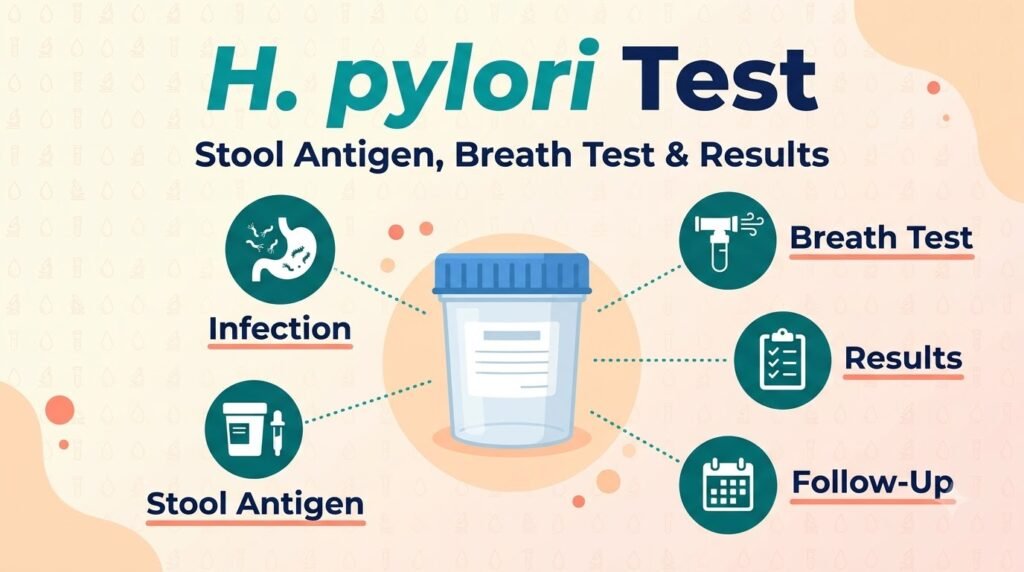
Helicobacter pylori (H pylori) is a type of bacteria that can live in the stomach lining. An H pylori test helps detect whether these bacteria are present, because symptoms alone cannot confirm an infection. The bacteria may cause inflammation of the stomach and are an important cause of peptic ulcers. Some people have indigestion, upper abdominal discomfort or nausea, while others have no noticeable symptoms.
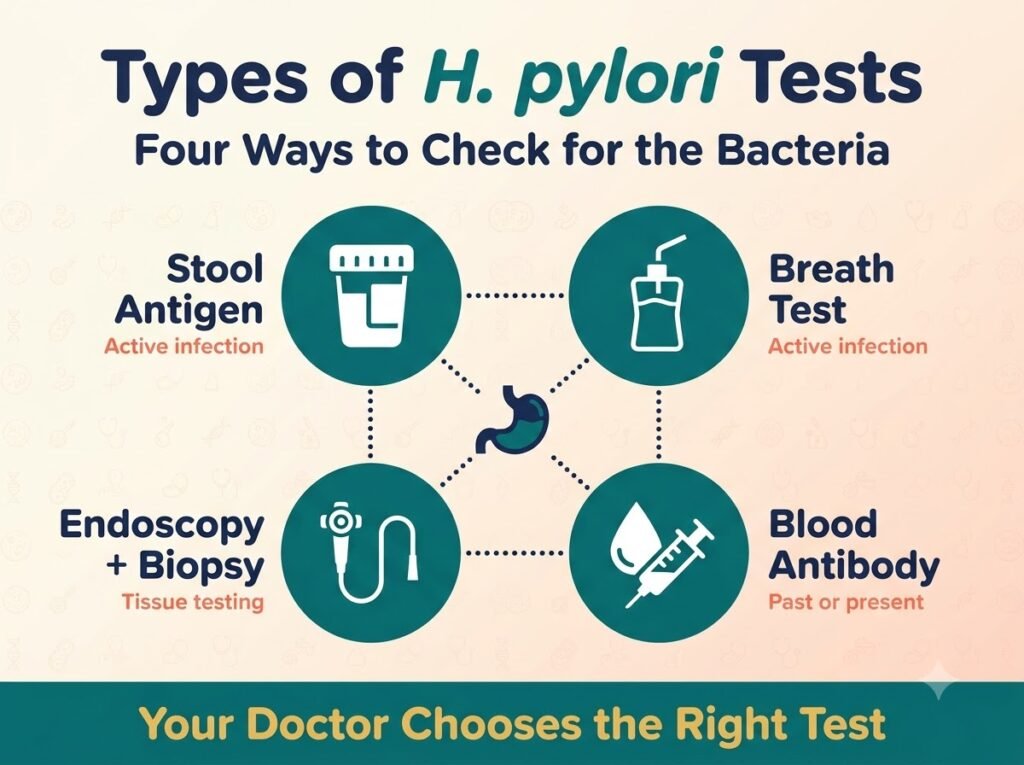
Common options for an H pylori test include the H. pylori stool antigen test and the H. pylori breath test (urea breath test) In selected cases, a doctor may recommend an endoscopy with a biopsy or another investigation.
Understanding the different H. pylori tests, their preparation requirements and the meaning of test results can help you discuss the right next steps with your healthcare professional.
📌 Quick Summary
| Test or question | Important information |
|---|---|
| H. pylori stool antigen test | Detects evidence of an active infection using a stool sample. |
| H. pylori breath test | Detects active infection by measuring labelled carbon dioxide in the breath. |
| Endoscopy with biopsy | Examines the upper digestive tract and allows tissue testing when clinically indicated. |
| H. pylori blood test | Detects antibodies but may not distinguish a current infection from a past infection. |
| Preparation | Recent antibiotics and acid-reducing medicines may affect test accuracy. |
| After treatment | A follow-up test is needed to confirm that the infection has cleared. |
Important: Stool antigen and urea breath tests are commonly used to detect active H. pylori infection and confirm successful treatment. The appropriate test depends on your medical history, symptoms and the reason for testing.
What Is H. pylori Infection?
H. pylori is a bacterium that can survive in the protective mucus layer of the stomach. In some people, it causes inflammation of the stomach lining, known as gastritis. It is also associated with stomach and duodenal ulcers.
Long-standing H. pylori infection is linked to an increased risk of certain stomach complications, including stomach cancer in some individuals. However, having the infection does not mean that a person will develop these complications.
H. pylori infection may be present without obvious symptoms. When symptoms occur, they can include:
- Upper abdominal discomfort or a burning sensation.
- Indigestion or a feeling of fullness after eating.
- Frequent bloating or belching.
- Nausea.
- Discomfort when the stomach is empty.
These symptoms can have several causes and do not confirm H. pylori infection. A healthcare professional may recommend testing based on your symptoms, medical history and examination. You can also read an overview of the infection on Mayo Clinic.
When Is an H Pylori Test Recommended?
A doctor may recommend an H. pylori test in situations such as:
- Suspected stomach or duodenal ulcers.
- Persistent upper abdominal discomfort or indigestion when testing is appropriate.
- A previously diagnosed infection that requires confirmation of successful treatment.
- Selected cases of stomach inflammation or other conditions where identifying the bacteria may influence management.
Testing is not automatically necessary for every person with gas, acidity or occasional indigestion. The decision depends on individual circumstances, including warning signs and other possible causes of symptoms.
If you have persistent digestive symptoms, consult a healthcare professional rather than relying on symptoms alone to identify the cause.
Types of H. pylori Tests
1. H. pylori Stool Antigen Test
The H. pylori stool antigen test checks a stool sample for antigens associated with the bacteria. It is a non-invasive test that can help identify an active infection.
It is also commonly used after treatment to check whether the infection has cleared, provided the test is performed at the appropriate time and with suitable preparation.
How does the test work?
A laboratory examines the submitted stool sample for evidence of H. pylori. You do not need an endoscopy for this test.
How to prepare:
- Obtain the appropriate sample container from the laboratory.
- Follow the laboratory’s instructions for collecting the sample.
- Avoid contaminating the sample with urine or toilet water.
- Tell your healthcare professional about antibiotics, bismuth-containing medicines and acid-reducing medicines you have recently taken.
- Follow the recommended timing and storage instructions.
Recent medicines may suppress the bacteria and cause a false-negative result. Do not stop prescribed medicines without medical advice.
When is it useful?
The stool antigen test can be used both for initial diagnosis and for checking whether H. pylori has been eradicated after treatment.
2. H. pylori Breath Test (Urea Breath Test)
The urea breath test is another non-invasive method used to detect active H. pylori infection.
How does the test work?
You provide an initial breath sample and then take a specially prepared substance containing labelled urea. If H. pylori is present, the bacteria break down the urea and produce labelled carbon dioxide, which can be detected in your breath.
The testing centre collects the required breath samples and analyses the results.
What should you expect?
The testing centre will explain the procedure and provide instructions about fasting, the test preparation and when to provide each breath sample. The exact procedure and duration may vary by testing facility.
When is it useful?
The urea breath test can help diagnose active H. pylori infection and confirm whether treatment has worked.
3. Endoscopy With Biopsy
An upper gastrointestinal endoscopy allows a doctor to examine the oesophagus, stomach and the first part of the small intestine using a thin, flexible tube with a camera.
During the procedure, the doctor may collect small tissue samples, called biopsies, to test for H. pylori and assess other conditions.
When might it be recommended?
Endoscopy may be considered when a doctor needs to investigate suspected ulcers, gastrointestinal bleeding, difficulty swallowing, persistent vomiting or other concerning symptoms.
It is more invasive than a stool antigen or breath test. It is not usually necessary solely to test for H. pylori when a suitable non-invasive test is sufficient.
4. H. pylori Blood Test
An H. pylori blood test usually looks for antibodies produced by the immune system in response to the bacteria.
A positive result may indicate current or previous exposure. However, antibodies can remain detectable even after the infection has cleared.
For this reason, a blood antibody test generally cannot confirm whether H. pylori is currently present or whether treatment has successfully eradicated it.
When the goal is to detect an active infection or confirm treatment success, a stool antigen test or urea breath test is often preferred.
H. pylori Tests Compared
| Feature | Stool antigen test | Urea breath test | Endoscopy with biopsy | Blood antibody test |
|---|---|---|---|---|
| Sample or procedure | Stool sample | Breath samples | Stomach tissue sample | Blood sample |
| Detects active infection | Yes | Yes | Can do so | Cannot reliably distinguish current from past infection |
| Requires an invasive procedure | No | No | Yes | No |
| Can confirm treatment success | Yes | Yes | In selected circumstances | Generally not suitable |
| Special preparation | Medicine timing and sample instructions | Medicine timing and centre-specific instructions | Procedure-specific preparation | Laboratory-specific instructions |
The best test is not necessarily the same for everyone. Your doctor will consider the reason for testing, your symptoms, recent medicines and whether further examination is needed.
How to Prepare for an H Pylori Test
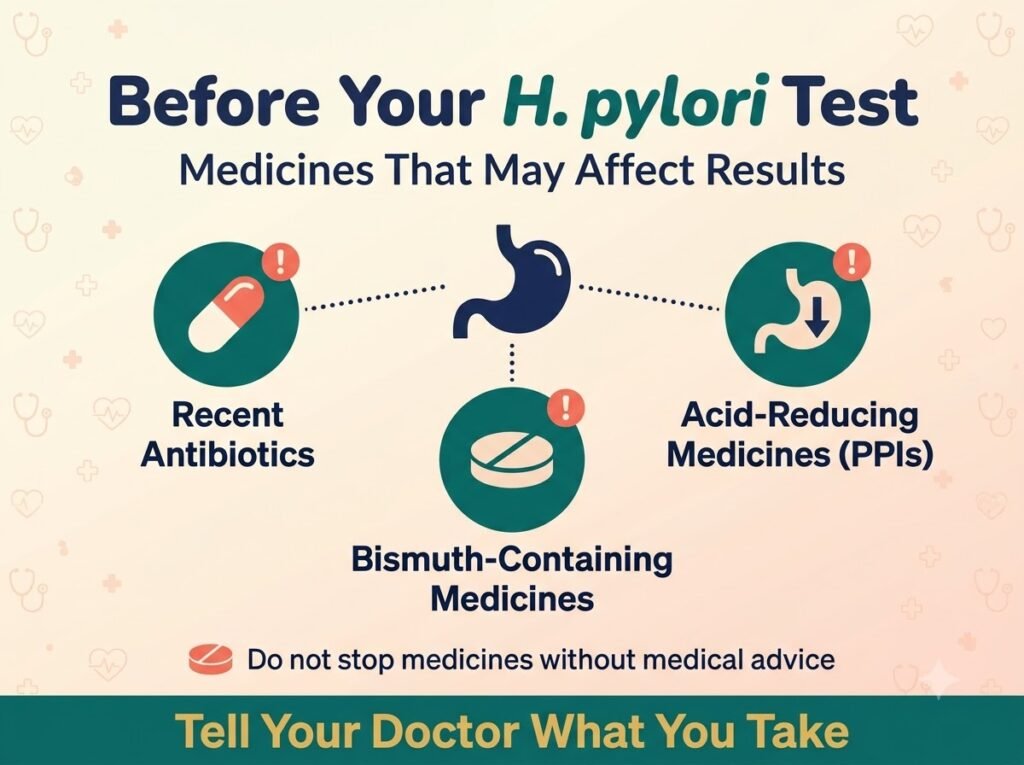
Correct H. pylori test preparation is important because certain medicines can interfere with stool antigen and urea breath test results.
Before your appointment, tell your healthcare professional about all medicines you take, including medicines for acidity, ulcers and other digestive conditions.
Medicines that may affect test accuracy
1. Antibiotics
Recent antibiotic use can reduce the number of bacteria and make an active infection harder to detect. Testing is commonly delayed until at least four weeks after antibiotics, depending on the clinical situation and the test protocol.
2. Acid-reducing medicines (proton pump inhibitors)
Proton pump inhibitors (PPIs) reduce stomach acid and may cause false-negative stool antigen or breath test results. A two-week pause is commonly recommended before these tests when it is medically safe. Check with your doctor or pharmacist whether any medicine you take belongs to this group.
3. Bismuth-containing medicines
Bismuth can also interfere with testing. Your healthcare professional may recommend avoiding it for a specified period before testing.
These are general preparation principles, not instructions to stop medication independently. Your doctor should confirm the appropriate timing for your circumstances and advise whether any temporary change is safe.
Do you need to fast?
Fasting requirements vary depending on the test and the laboratory’s protocol. A urea breath test commonly requires fasting for a specified period, while stool sample collection follows separate instructions.
Always follow the instructions given by the testing centre rather than assuming that the same preparation applies to every H. pylori test.
How to Collect an H. pylori Stool Sample
If your doctor recommends a stool antigen test, follow the laboratory’s collection instructions carefully.
- Use the correct container: Obtain a clean, approved specimen container from the laboratory.
- Collect the sample carefully: Use the collection device or surface recommended by the laboratory.
- Prevent contamination: Keep the stool sample free from urine, toilet water and cleaning products.
- Transfer the sample: Use the supplied tool, if provided, and collect the amount requested.
- Close the container securely: Label it as instructed by the laboratory.
- Store and return it correctly: Follow the laboratory’s instructions regarding storage, temperature and delivery time.
- Wash your hands: Wash thoroughly after handling the specimen.
If you are unsure how to collect or store the sample, ask the laboratory staff before submitting it. Incorrect collection or storage may affect whether the sample can be tested.
What Do H. pylori Test Results Mean?
The meaning of a result depends on the type of test, your recent medication use and the reason the test was performed.
H. pylori Positive Result (Stool Antigen or Breath Test)
A positive result generally supports the presence of an active H. pylori infection.
Your doctor will interpret the result alongside your symptoms, medical history and any other relevant findings. If an active infection is confirmed, the doctor can recommend an appropriate treatment plan.
Do not start antibiotics on your own. Treatment selection requires consideration of allergies, previous antibiotic use, local resistance patterns and other individual factors.
H. pylori Negative Result (Stool Antigen or Breath Test)
A negative result means the test did not detect evidence of infection.
However, it may not completely rule out H. pylori in every situation. Recent antibiotics, bismuth-containing medicines, acid-reducing medicines or inadequate preparation can contribute to a false-negative result.
If symptoms persist or your doctor still suspects an infection, ask whether the test timing, preparation or choice of investigation needs to be reviewed.
Positive blood antibody test
A positive antibody result indicates that your immune system has responded to H. pylori at some point. It does not necessarily mean that the bacteria are still present.
A different test may be needed to determine whether there is an active infection.
What if the report says borderline or equivocal?
Some laboratories may report a result as borderline, indeterminate or equivocal. This means the result does not clearly establish whether the test is positive or negative.
Your healthcare professional may recommend repeating the test, reviewing preparation or choosing another investigation. Do not interpret an equivocal result as proof of infection or proof that the bacteria are absent.
Why Follow-Up Testing Matters: H. pylori Test After Treatment
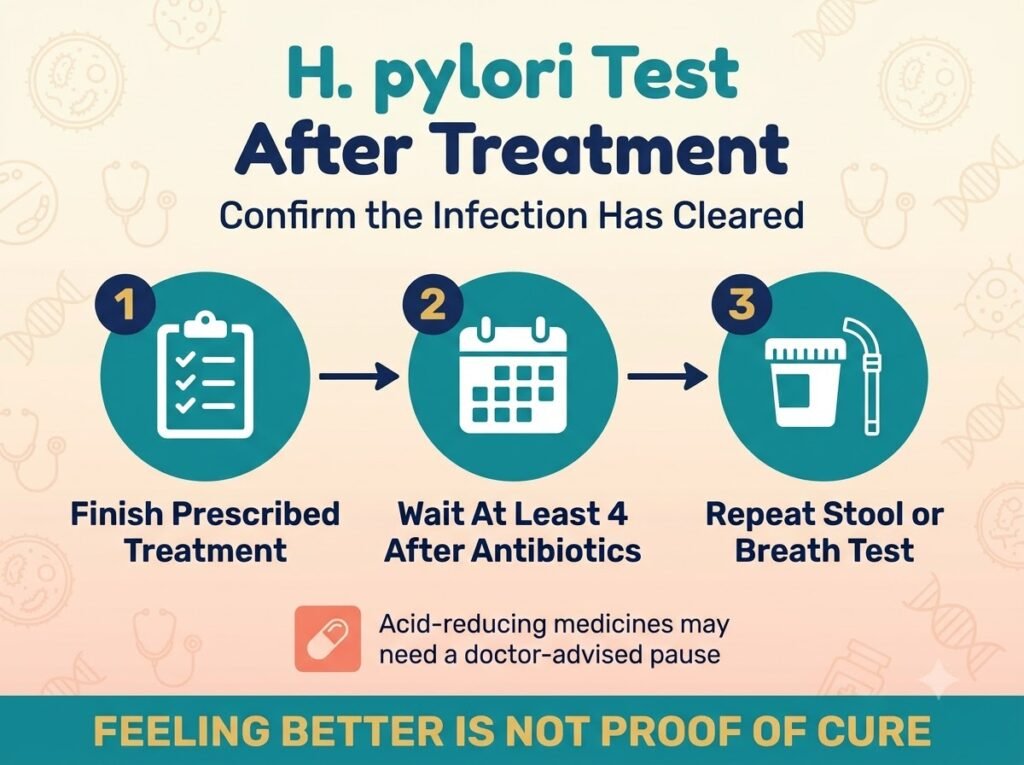
Completing treatment and feeling better are encouraging, but neither proves that H. pylori has been eradicated.
Clinical guidance recommends confirming eradication after treatment for diagnosed H. pylori infection. This is generally done using a urea breath test, stool antigen test or an appropriate biopsy-based test. The American College of Gastroenterology guideline discusses treatment and confirmation of eradication in detail.
For many patients, an H. pylori test after treatment is performed at least four weeks after completing antibiotic treatment. Acid-reducing medicines (PPIs) are commonly withheld for two weeks before testing when medically safe, while bismuth and antibiotics require an appropriate washout period.
Your doctor will determine the correct timing and whether any temporary medicine adjustment is appropriate.
A follow-up test is important because persistent infection may require further medical assessment and a revised treatment plan. Do not take leftover antibiotics or repeat a previous treatment regimen without medical advice.
Can H. pylori Infection Be Prevented?
H. pylori transmission is not fully understood in every case, but contaminated food or water and person-to-person transmission may play a role.
General hygiene practices can help reduce exposure to gastrointestinal infections:
- Wash your hands with soap and water after using the toilet.
- Wash your hands before preparing or eating food.
- Use safe drinking water.
- Wash fruits and vegetables carefully.
- Maintain clean food preparation and storage practices.
These measures support general digestive health but cannot guarantee that H. pylori infection will be prevented. There is no need to assume that a person with H. pylori has poor hygiene or has done something wrong.
When Should You Seek Medical Attention?
Indigestion, bloating and upper abdominal discomfort can have several causes. Some symptoms require medical assessment rather than simply arranging an H. pylori test.
Seek urgent medical care if you experience:
- Vomiting blood or material that resembles coffee grounds.
- Black, tarry stools, which may indicate gastrointestinal bleeding.
- Sudden or severe abdominal pain.
- Fainting or severe dizziness, especially with signs of bleeding.
Arrange prompt medical review if you experience:
- Difficulty swallowing.
- Repeated or persistent vomiting.
- Unexplained weight loss.
- Ongoing digestive symptoms.
- Suspected anaemia or unusual persistent weakness.
Do not delay urgent care while waiting for a test appointment or result. A healthcare professional may recommend endoscopy or another investigation depending on your symptoms. The NHS page on stomach ulcers lists symptoms and when to get help.
Frequently Asked Questions About H. pylori Testing
1. Which H. pylori test is best?
The stool antigen test and urea breath test are commonly used to detect active infection and confirm treatment success. Endoscopy with biopsy may be appropriate when further examination is needed. Your doctor can recommend the most suitable option.
2. Is the H. pylori stool antigen test accurate?
The stool antigen test is a widely used method for detecting active H. pylori infection. Accuracy depends on the test method, sample handling and correct preparation. Recent antibiotics, bismuth or acid-reducing medicines can affect results.
3. Does an H. pylori test require fasting?
Not every test has the same requirements. A breath test may require fasting, while a stool antigen test requires correct sample collection. Follow the instructions provided by your laboratory.
4. Can I take acidity medicine before an H. pylori test?
Some acidity medicines, particularly proton pump inhibitors, can affect stool antigen and breath test results. Tell your doctor what you take and ask whether a temporary pause is needed. Do not stop prescribed medicine independently.
5. Can a blood test confirm active H. pylori infection?
A blood antibody test cannot reliably distinguish a current infection from a previous one because antibodies may remain after the bacteria have cleared. Stool antigen or breath testing is generally more useful for assessing active infection.
6. How soon should I repeat an H. pylori test after treatment?
Follow-up testing is generally performed at least four weeks after completing antibiotic treatment. Certain medicines also need to be withheld for a period before testing, if medically safe. Your doctor will confirm the appropriate schedule.
7. Does a negative result mean I definitely do not have H. pylori?
Not always. A negative result may be unreliable if testing was performed too soon after certain medicines or without proper preparation. If symptoms continue, consult your doctor about whether further testing is needed.
8. Can H. pylori infection return after treatment?
Persistent infection can occur when treatment does not eradicate the bacteria, and reinfection is also possible. A properly timed follow-up test helps determine whether treatment has worked.
9. Can I treat H. pylori with home remedies?
Home remedies and dietary changes have not been established as reliable substitutes for medical treatment that eradicates H. pylori. If testing confirms infection, discuss evidence-based treatment with a healthcare professional.
10. Does everyone with acidity need an H. pylori test?
No. Acidity and indigestion can have many causes. A doctor decides whether H. pylori testing is appropriate based on symptoms, medical history, examination and warning signs.
Final Takeaway
The H. pylori stool antigen test and urea breath test are commonly used to identify active infection and confirm whether treatment has worked. Endoscopy with biopsy may be recommended when a doctor needs to investigate other digestive problems, while blood antibody testing has limitations in distinguishing current from past infection.
Correct preparation, appropriate timing and professional interpretation are essential for reliable results. If an infection is confirmed, follow your prescribed treatment and complete the recommended follow-up testing.
If you have persistent indigestion, upper abdominal discomfort or concerning symptoms, consult a qualified healthcare professional to determine the appropriate investigation.
Related Reading
Long-standing stomach problems can sometimes go along with low iron or vitamin B12, so you may also like these guides from Health Partner India:
- Iron Deficiency Symptoms: Causes, Tests & Treatment Guide
- Vitamin B12 Deficiency: Symptoms, Causes & Test Guide (replace with the exact B12 article URL)
- More health guides on the Health Partner India blog
Medical References
- American College of Gastroenterology (ACG): Clinical Guideline on Treatment of Helicobacter pylori Infection
- NHS: Stomach ulcer
- Mayo Clinic: H. pylori infection
📲 Need Help With H. pylori Test or Other Lab Tests?
Health Partner India helps you with lab test booking, medicine ordering, doctor consultations and health check-up packages. Message us on WhatsApp and our team will guide you and arrange the booking on your behalf.
- 💬 WhatsApp: Chat with us on +91 93479 68950
- 📸 Instagram: @healthpartner.india
- 👍 Facebook: Health Partner India
- 🌐 Website: healthpartner.co.in
Medical disclaimer: This article is for general educational purposes only. It does not replace professional medical advice, diagnosis or treatment. Test selection, preparation, result interpretation and treatment should be discussed with a qualified healthcare professional.