
A Urine Routine Test, also called Urine Routine Examination (Urine R/E), is one of the most commonly performed laboratory tests. It examines urine for physical, chemical and microscopic abnormalities.
A urine test can give useful information about the urinary tract, kidneys, hydration status and certain metabolic conditions. Doctors often recommend it when someone has symptoms such as burning while urinating, frequent urination, lower abdominal discomfort, fever or blood in the urine.
However, a urine report should never be judged from one number alone. The result needs to be read alongside your symptoms, medical history and, when required, other investigations.
This guide explains urine routine test normal ranges, pus cells, RBC, epithelial cells, bacteria, protein, glucose, crystals — and how to actually understand your urine report.
📌 Quick Summary
| Urine Test Parameter | What It May Indicate |
|---|---|
| Colour | Hydration and other factors |
| Appearance | Clarity of urine |
| pH | Acidity / alkalinity |
| Specific gravity | Urine concentration |
| Protein | May need evaluation if persistently elevated |
| Glucose | May be associated with elevated blood glucose |
| Ketones | May occur in fasting, vomiting, diabetes and other situations |
| RBC | Red blood cells in urine |
| Pus cells / WBC | White blood cells; may occur with urinary inflammation or infection |
| Epithelial cells | Cells shed from the urinary tract or genital area |
| Bacteria | May indicate infection, contamination or colonisation depending on context |
| Crystals | May occur for several reasons, including concentrated urine |
What Is a Urine Routine Test?
A urine routine test examines a urine sample using several methods:
- Physical examination
- Chemical examination
- Microscopic examination
Depending on the laboratory, the report may include:
Colour · Appearance · pH · Specific gravity · Protein · Glucose · Ketones · Bilirubin · Urobilinogen · Blood/RBC · Pus cells/WBC · Epithelial cells · Crystals · Casts · Bacteria
The exact parameters and reference ranges vary between laboratories.
Why Is a Urine Routine Test Done?
A doctor may recommend a urine routine test when evaluating:
- Burning or pain during urination
- Frequent urination
- Urgency to urinate
- Lower abdominal discomfort
- Blood in urine
- Fever with urinary symptoms
- Suspected urinary tract infection
- Certain kidney problems
- Protein in urine
- Diabetes-related concerns
- Routine health screening
A urine test is also included in many full-body health-checkup packages.
Urine Routine Test Normal Range
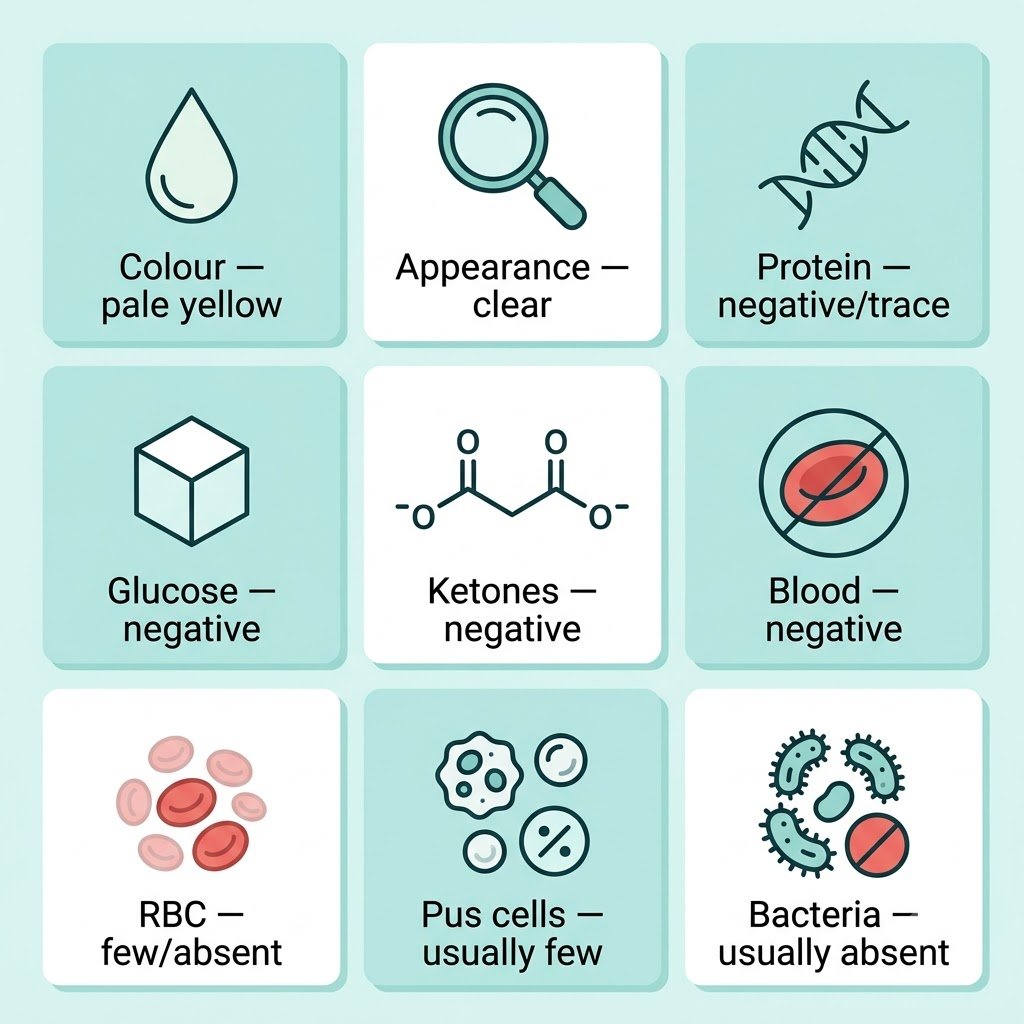
There is no single universal “normal urine report”, because reference ranges differ between laboratories.
Some commonly reported findings are:
| Parameter | Common Finding / Reference |
|---|---|
| Colour | Pale yellow to yellow |
| Appearance | Clear or slightly clear |
| Protein | Negative or trace |
| Glucose | Negative |
| Ketones | Negative |
| Bilirubin | Negative |
| Blood | Negative |
| RBC | Usually few or absent |
| Pus cells / WBC | Usually few |
| Epithelial cells | Few may be reported |
| Bacteria | Usually absent |
Important: Always compare your result with the reference range printed on your own laboratory report.
Pus Cells in Urine
Pus cells usually refer to white blood cells (WBCs) seen during urine microscopy.
A small number may be reported in some healthy individuals.
An increased number can occur with:
- Urinary tract infection
- Urinary inflammation
- Kidney or urinary tract conditions
- Contamination of the sample
- Other causes of urinary inflammation
Pus cells should not be interpreted on their own. Pus cells plus urinary symptoms plus other supportive findings may increase suspicion of a UTI — but an elevated pus-cell count by itself does not prove that an infection is present.
What Does “Pus Cells 1–2” or “2–4” Mean?
Small numbers of pus cells are often reported in otherwise normal urine samples, for example:
Pus cells: 1–2/HPF or Pus cells: 2–4/HPF
These findings should be read against your laboratory’s reference range and your symptoms.
If you have burning urination, frequent urination, urgency, fever or lower abdominal pain, discuss the result with your doctor even when the number looks small.
What Does “Pus Cells 8–10/HPF” Mean?
A result such as Pus cells: 8–10/HPF is higher than the small numbers commonly seen on microscopy, and may require further evaluation — especially when urinary symptoms are present.
Possible explanations include:
- Urinary tract infection
- Urinary inflammation
- Sample contamination
- Other urinary tract conditions
A doctor may consider a urine culture when infection is suspected, particularly where identifying the responsible organism and the appropriate antibiotic matters.
Do not start antibiotics simply because pus cells are elevated.
RBC in Urine
RBC means red blood cells.
A small number may occasionally be seen, but blood detected in urine can have several possible causes:
- Urinary tract infection
- Kidney stones
- Menstrual contamination
- Trauma
- Certain kidney conditions
- Other urinary tract problems
If blood in the urine is persistent, or visible to the naked eye, medical evaluation is important.
Epithelial Cells in Urine
Epithelial cells naturally line parts of the urinary and genital tract, so a few in a sample are common.
A larger number can sometimes suggest contamination, particularly if the sample was not collected carefully. Interpretation depends on the type of epithelial cells, the quantity and the other findings on the report.
Bacteria in Urine
Bacteria may be reported on urine microscopy. However, bacteria in a urine sample do not always mean you have a UTI — they can also appear because of contamination during collection.
Doctors usually consider:
- Symptoms
- Pus cells / WBC
- Urine appearance
- Nitrite and leukocyte esterase, where tested
- Urine culture
- Medical history
before deciding whether a UTI is likely.
Protein in Urine
Protein is normally absent, or present only in very small amounts, in urine.
Persistent protein in urine can sometimes be associated with kidney disease. Temporary proteinuria may occur with:
- Fever
- Dehydration
- Intense exercise
- Certain illnesses
If protein remains elevated on repeat testing, your doctor may recommend further kidney evaluation.
Read: Kidney Function Test (KFT): Normal Range & How to Read Your Report
Glucose in Urine
Normally, urine contains little or no glucose.
Glucose can appear in urine when blood glucose is sufficiently elevated, although the relationship is not always straightforward. If urine glucose is detected, your doctor may recommend blood glucose testing.
Read: Normal Blood Sugar Level Chart: Fasting, Post-Meal & HbA1c and HbA1c Test: Normal Range, Prediabetes & Diabetes Levels
Urine pH
Urine pH describes how acidic or alkaline the urine is. Diet, hydration, medicines and certain medical conditions can all influence it.
A urine pH result should not be treated as a diagnosis on its own.
Specific Gravity
Specific gravity indicates how concentrated the urine is. It can be influenced by:
- Fluid intake
- Dehydration
- Kidney function
- Certain medical conditions
Your doctor will interpret it together with other urine and blood-test findings.
Crystals in Urine
Some urine reports mention crystals. These can occur for several reasons, including:
- Concentrated urine
- Dietary factors
- Urine chemistry
- Certain medications
- Risk of some types of kidney stones
The type and quantity of crystals matter. If crystals are repeatedly reported, or you have symptoms such as severe side pain or blood in urine, discuss the result with your doctor.
Do You Need to Fast Before a Urine Routine Test?
A standard urine routine test generally does not require fasting.
However, if your doctor or laboratory has ordered urine testing together with fasting blood tests, follow the preparation instructions given for the complete package.
How to Collect a Urine Sample Correctly
For most routine urine tests, a clean-catch midstream sample is recommended:
- Wash your hands.
- Clean the genital area according to the laboratory’s instructions.
- Begin urinating.
- Collect the midstream portion in the sterile container.
- Avoid touching the inside of the container.
- Close the container properly.
- Submit the sample as instructed by the laboratory.
If you are menstruating, tell the laboratory — menstrual blood can affect some urine results.
Urine Routine Test vs Urine Culture

These are two different tests.
Urine Routine Test — examines the physical, chemical and microscopic characteristics of urine.
Urine Culture — determines whether bacteria or other organisms grow from the urine sample and, when appropriate, helps guide antibiotic selection.
A doctor may order a urine culture when a bacterial UTI is suspected.
When Should You See a Doctor?
Speak with a healthcare professional if you have:
- Burning while urinating
- Frequent urination
- Urgent need to urinate
- Blood in urine
- Fever with urinary symptoms
- Lower abdominal pain
- Back or side pain
- Repeated abnormal urine reports
- Persistent protein in urine
Seek urgent medical attention if you have severe pain, high fever with chills, vomiting, confusion or a rapid deterioration in health.
Frequently Asked Questions
1. What is a urine routine test? It is a laboratory examination of urine that may include physical, chemical and microscopic testing.
2. What is the normal range of pus cells in urine? A small number may be seen in normal urine. Use your laboratory’s reference range, because reporting methods vary.
3. Does pus in urine always mean UTI? No. Increased pus cells can occur with infection or other causes of inflammation, and contamination can also affect the result.
4. What does bacteria in urine mean? Bacteria may be associated with infection, but can also result from contamination. Symptoms and other findings matter.
5. Can a urine routine test detect kidney disease? It can provide useful clues, such as protein or blood in urine, but it cannot diagnose every kidney condition by itself.
6. Does a urine routine test require fasting? Usually no. Follow your laboratory’s instructions if several tests have been ordered together.
7. What does RBC in urine mean? RBCs are red blood cells. Blood in urine has several possible causes and needs medical evaluation if persistent.
8. What do epithelial cells in urine mean? A small number may be normal. A large number can sometimes indicate sample contamination.
9. Is a urine culture the same as a urine routine test? No. A routine test examines urine characteristics; a culture looks for growth of organisms and can help guide treatment when infection is suspected.
10. Can I diagnose a UTI from a urine report myself? It is better not to. A doctor should consider the report together with your symptoms and, where appropriate, a urine culture.
Final Takeaway
A urine routine test is a simple and useful investigation, but one abnormal value does not automatically mean you have a disease.
When reading your report, look at the complete picture — pus cells/WBC, RBC, protein, glucose, bacteria, epithelial cells, pH, specific gravity, your symptoms, and any other tests your doctor recommends.
If you have an abnormal result or ongoing symptoms, discuss the report with a qualified healthcare professional rather than starting treatment based on the report alone.
🔗 Related Reading
- Kidney Function Test (KFT): Normal Range & How to Read Your Report
- Liver Function Test (LFT): SGPT & SGOT Normal Range
- Normal Blood Sugar Level Chart: Fasting, Post-Meal & HbA1c
- HbA1c Test: Normal Range, Prediabetes & Diabetes Levels
- How to Read Your Lipid Profile Report: Complete Guide
📚 External References
- MedlinePlus (US National Library of Medicine) — Urinalysis
- National Kidney Foundation — https://www.kidney.org
- NHS UK — Urinary tract infections (UTIs) — https://www.nhs.uk/conditions/urinary-tract-infections-utis/
- National Institute of Diabetes and Digestive and Kidney Diseases (NIDDK) — Bladder infection (UTI) in adults — https://www.niddk.nih.gov/health-information/urologic-diseases/bladder-infection-uti-in-adults
- World Health Organization — Antimicrobial resistance — https://www.who.int/news-room/fact-sheets/detail/antimicrobial-resistance
⚕️ Medical Disclaimer
This article is for general educational and informational purposes only. It does not provide medical diagnosis or treatment.
Urine-test reference ranges vary between laboratories. A single abnormal result should not be used to self-diagnose a UTI, kidney disease or any other medical condition.
Do not start antibiotics or other medicines based only on a urine report. Consult a qualified healthcare professional when symptoms or abnormal results are present.
HealthPartner India is a healthcare assistance and information platform. We help customers access and book diagnostic tests through our partner network, but we do not provide medical diagnosis or treatment.
🧪 Need Help Booking a Urine Test?
HealthPartner India can help you check current urine-test availability and pricing through our diagnostic partner network.
We can help you check tests such as:
- Urine Routine Examination (Urine R/E)
- Urine Culture & Sensitivity
- Kidney Function Test (KFT)
- Blood Sugar Tests and HbA1c
- Full-Body Health Checkup Packages
📱 WhatsApp: +91 93479 68950
HealthPartner India can help you enquire about diagnostic booking options through Tata 1mg where offered. Availability, pricing, home collection and fulfilment depend on your location and the provider.