
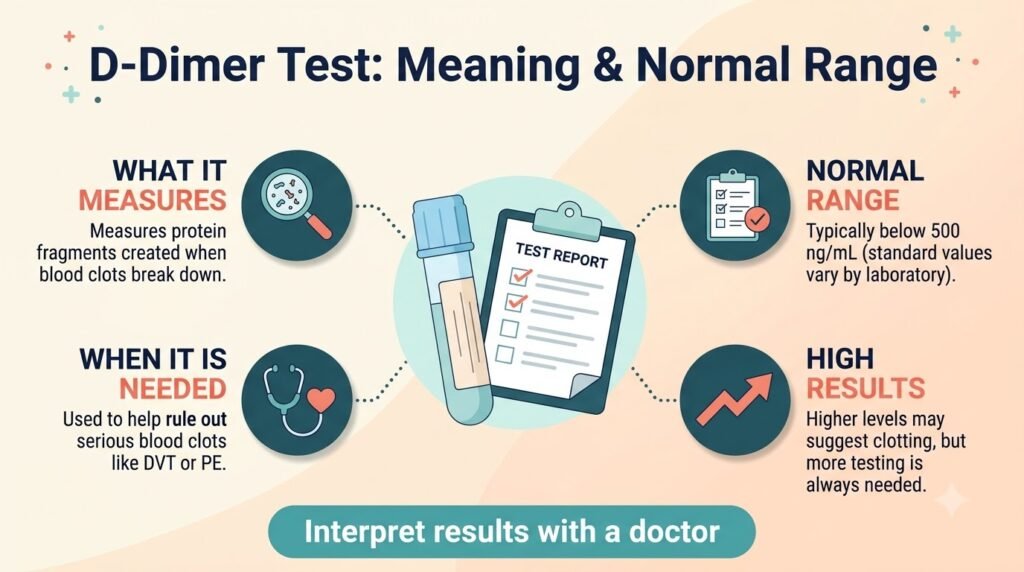
Quick answer: A D-dimer test measures fragments released when the body breaks down cross-linked fibrin. It can help clinicians assess suspected deep vein thrombosis (DVT) or pulmonary embolism (PE), but a high result does not confirm a clot. Results must be interpreted alongside symptoms, clinical risk and the laboratory’s reference range.
Who this guide is for: This guide is for adults who have been advised to take a D-dimer blood test, are reviewing a laboratory report, or want to understand why a clinician may request this test when assessing possible DVT or pulmonary embolism. Use it to prepare questions for your healthcare professional—not to diagnose a clot, decide whether testing is necessary, or choose treatment yourself.
Key Takeaway
A D-dimer test can help rule out a blood clot in selected patients when used with an appropriate clinical assessment, but a high result does not prove that a clot is present. The result, symptoms, clinical risk and laboratory-specific reference range must be considered together. Seek emergency care for sudden breathlessness, chest pain, coughing up blood or collapse.
Last updated: 25 October 2026.
The D-dimer test measures a substance released when the body breaks down fibrin, a protein involved in forming blood clots. Doctors may recommend it when symptoms suggest DVT or PE, but several other conditions can also increase the level.
Understanding the result, the limits of the test and when further testing may be needed can help you have a more informed discussion with your doctor. If you have new one-sided leg swelling or pain, seek prompt medical advice. Sudden breathlessness, chest pain, coughing up blood or collapse requires emergency assessment.
What Is a D-Dimer Test?
A D-dimer test measures fragments of fibrin that enter the bloodstream when the body breaks down blood clots.
Blood clotting is a normal process that helps stop bleeding after an injury. Once a clot is no longer needed, the body gradually breaks it down. D-dimer is one of the fragments produced during this process.
Doctors may use the test as part of an assessment for suspected abnormal clot formation, particularly deep vein thrombosis and pulmonary embolism.
The result is not a diagnosis on its own. A doctor considers the test alongside symptoms, medical history, physical examination and, when necessary, imaging tests.
What Is the Full Form of D-Dimer?
D-dimer is not an abbreviation with a conventional full form. The name refers to a specific protein fragment formed during the breakdown of cross-linked fibrin.
In simple terms, the test looks for evidence of increased fibrin breakdown in the body. This can help doctors assess certain conditions involving blood clots, but it cannot identify the exact cause of an abnormal result by itself.
Why Is a D-Dimer Test Done?
A doctor may recommend a D-dimer test when a person has symptoms or risk factors that raise concern about a blood clot.
Common reasons include:
1. Suspected deep vein thrombosis (DVT)
DVT occurs when a blood clot forms in a deep vein, commonly in the leg. Possible symptoms include swelling, pain, tenderness, warmth or a change in skin colour in one leg.
Learn more about deep vein thrombosis.
2. Suspected pulmonary embolism (PE)
Pulmonary embolism occurs when a blood clot blocks a blood vessel in the lungs. A D-dimer test may be part of the assessment when a doctor suspects this condition.
3. Assessment of suspected abnormal clotting
Depending on the clinical situation, doctors may use the test when evaluating possible clotting-related problems or certain other medical conditions.
4. Supporting a diagnostic decision
For people assessed as having a low or unlikely probability of DVT or PE, a negative D-dimer result using an appropriate, validated threshold can help a doctor rule out these conditions. People with a higher clinical probability may need imaging or other investigations instead.
The test should always be interpreted according to the patient’s symptoms and clinical risk.
What Is the Normal Range of a D-Dimer Test?
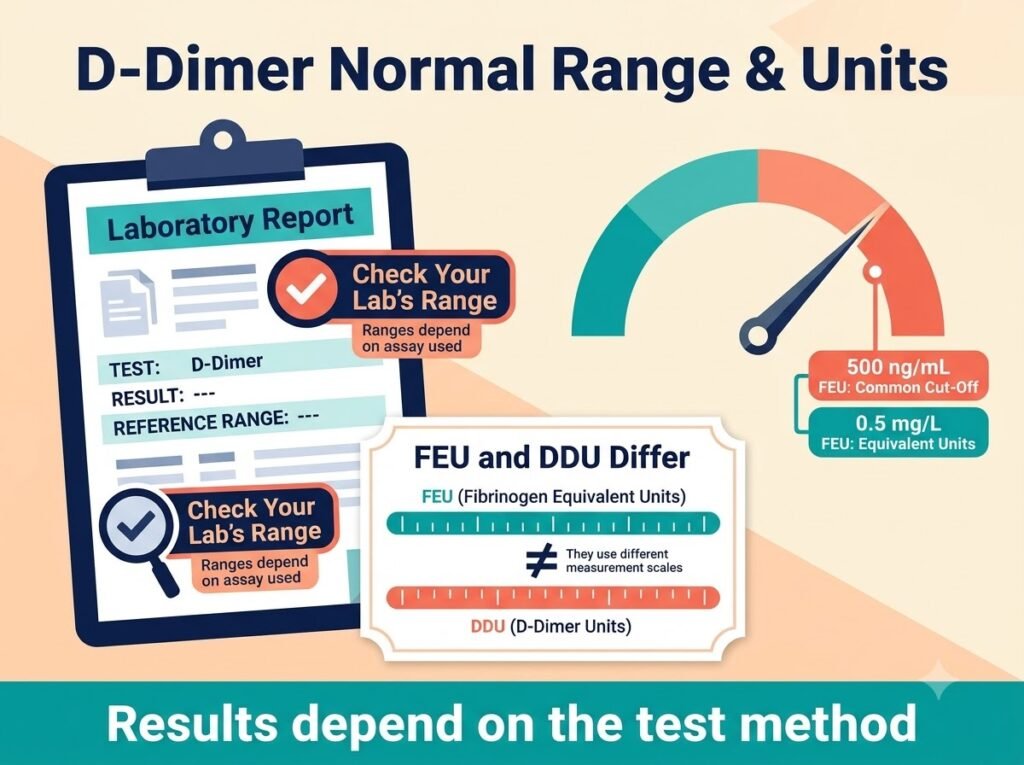
There is no single reference range that applies to every laboratory and every D-dimer assay. The result depends on the testing method, units and reference limit used by the laboratory.
A commonly used threshold for some assays is:
- 500 ng/mL FEU
- 0.5 mg/L FEU
- 0.5 µg/mL FEU
These values are equivalent when expressed in the units shown above, but the laboratory’s own assay and reporting method must be considered.
Some laboratories report D-dimer in DDU units rather than FEU units. FEU and DDU values are not directly interchangeable; the correct interpretation depends on the specific assay and the laboratory’s reference range.
Always compare your result with the reference interval printed on your report rather than relying on a number found online.
Can the Normal D-Dimer Cut-Off Change With Age?
Yes. In selected adults older than 50, doctors may use an age-adjusted D-dimer threshold when assessing suspected pulmonary embolism or deep vein thrombosis, depending on the clinical pathway and assay.
One commonly used approach for certain assays is age multiplied by 10 ng/mL FEU for people over 50. For example, a 60-year-old may have an age-adjusted threshold of 600 ng/mL FEU under that specific approach.
This is not a universal rule for every laboratory or clinical situation. A doctor must confirm whether an age-adjusted threshold is appropriate for the test being used.
Pregnancy can also affect D-dimer levels. Pregnant patients require clinical assessment using an appropriate pathway rather than interpreting the result against a standard reference range alone.
What Does a High D-Dimer Result Mean?
A high D-dimer result means that the measured level is above the laboratory’s stated threshold. It does not confirm that a blood clot is present.
Doctors may investigate further depending on the symptoms, medical history and overall likelihood of a clot.
Possible reasons for a raised D-dimer include:
- Deep vein thrombosis or pulmonary embolism
- Recent surgery or significant injury
- Infection or inflammation
- Increasing age
- Pregnancy
- Certain heart conditions
- Some cancers
- Other conditions associated with increased clot formation or breakdown
These are possible explanations, not a diagnosis. The significance of a raised result depends on the person’s clinical situation. If your doctor is investigating infection or inflammation, you may also find our guides to the CRP test and its results and the liver function test helpful for understanding what those separate tests measure. They do not replace a clinical assessment of a possible blood clot.
Does a High D-Dimer Always Mean a Blood Clot?
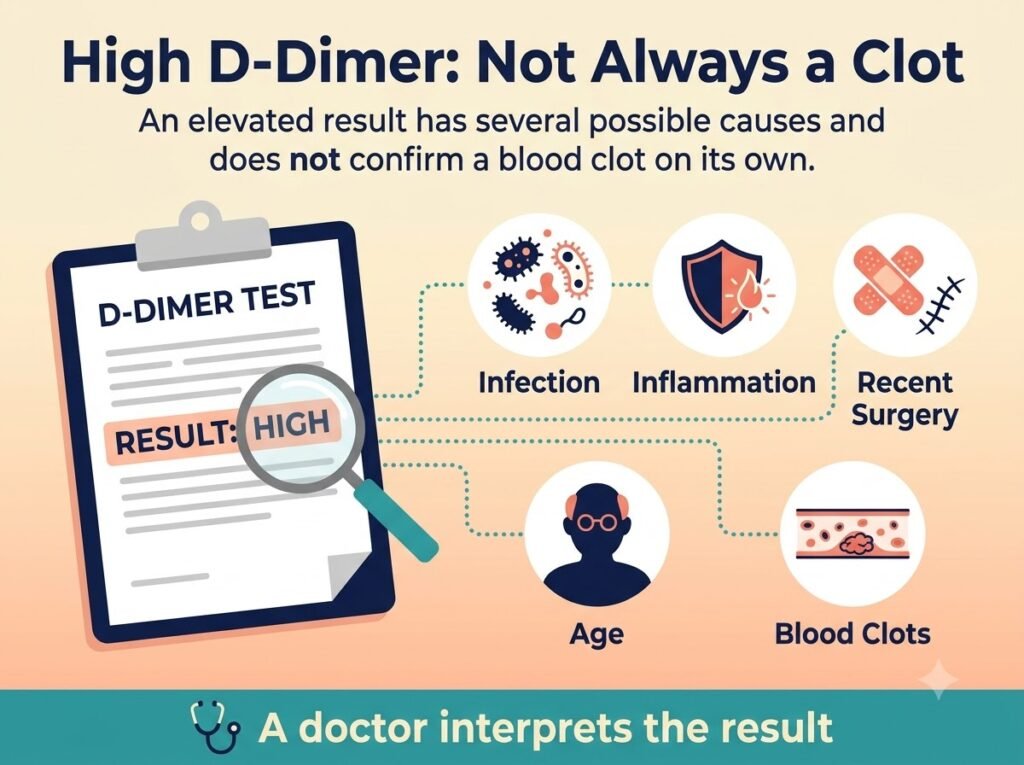
No. D-dimer is a sensitive but nonspecific test. It can be elevated in several situations that do not involve DVT or PE.
For example, a person may have an elevated result following surgery or during an infection. A doctor may therefore recommend additional assessment rather than concluding that a clot is present from the blood test alone.
Depending on the symptoms and clinical findings, further investigations may include a leg vein ultrasound or CT pulmonary angiography. The appropriate test depends on the suspected condition.
Do not start aspirin, anticoagulants or other blood-thinning medicines based only on a D-dimer result unless a qualified clinician advises you to do so.
What Does a Normal or Negative D-Dimer Result Mean?
A result below the appropriate threshold can help rule out DVT or PE in selected patients whose clinical probability is low or unlikely.
However, a negative result does not exclude every possible clotting problem in every situation. Interpretation may be affected by the clinical circumstances, the test used and when the sample was collected.
If you continue to have concerning symptoms, seek medical advice even if your D-dimer result is within the laboratory’s reference range.
Your doctor may recommend additional testing if the clinical assessment indicates that it is necessary.
How Is the D-Dimer Test Performed?
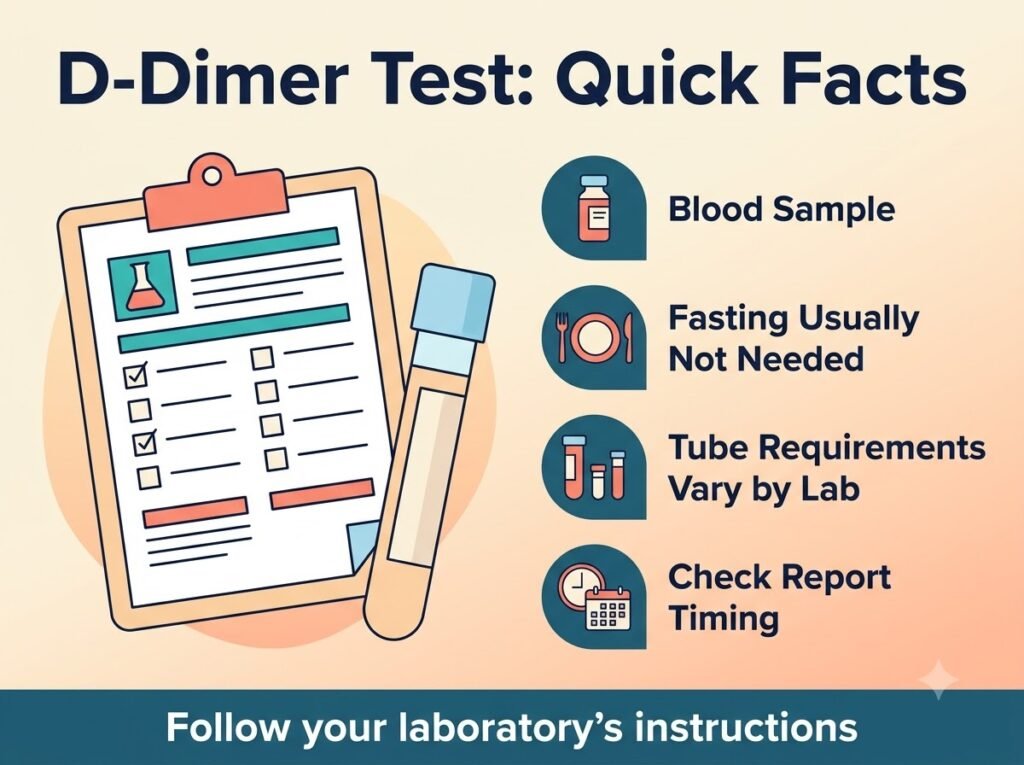
The D-dimer test is performed using a blood sample collected by a healthcare professional.
The sample is generally collected into a tube containing sodium citrate, often identified by a light-blue cap. The laboratory uses a specific testing method to measure D-dimer in the sample.
The laboratory’s collection and handling instructions should always be followed because requirements can vary.
Is Fasting Required for a D-Dimer Test?
Fasting is usually not required when a D-dimer test is performed on its own.
If you are having other blood tests at the same time, some of those tests may have separate preparation requirements. Confirm the instructions with the laboratory or your doctor before the appointment.
When Will the D-Dimer Report Be Available?
Reporting time varies by laboratory, location, sample collection arrangements and testing workload.
Ask the laboratory for its current estimated turnaround time when booking the test. If the test is being performed because of possible DVT or pulmonary embolism, do not delay urgent medical assessment while waiting for a routine laboratory appointment or report.
D-Dimer Test vs Other Investigations
The D-dimer test is only one part of evaluating a possible blood clot. Other tests answer different questions.
D-dimer blood test: Measures fragments associated with fibrin breakdown. It can help rule out DVT or PE in selected patients when used with an appropriate clinical assessment.
Venous Doppler ultrasound: Uses ultrasound to assess blood flow and look for clots in veins, particularly in the legs.
CT pulmonary angiography: Uses CT imaging and contrast material to look for blood clots in the blood vessels of the lungs when pulmonary embolism is suspected.
Other blood tests: Depending on the situation, a doctor may request additional tests to assess other possible causes of symptoms or to evaluate general health.
These tests are not interchangeable. Your doctor decides which investigation is suitable based on your symptoms, examination and risk assessment.
When Should You Seek Medical Attention?
A possible blood clot should not be assessed using a laboratory result alone.
Seek urgent medical assessment if you develop new, unexplained swelling or pain in one leg, particularly if the leg is warm or tender.
Call your local emergency service or go to an emergency department immediately if you experience:
- Sudden or severe difficulty breathing
- New or unexplained chest pain, especially pain that worsens when breathing
- Coughing up blood
- Fainting or collapse, particularly with breathlessness or chest pain
These symptoms can have several causes, but they may indicate a serious condition such as pulmonary embolism. Do not wait for a D-dimer test or an online interpretation before seeking urgent care.
Frequently Asked Questions About the D-Dimer Test
1. Is the D-dimer test used to detect blood clots?
It can help doctors assess the possibility of a blood clot. However, it does not directly show the location of a clot and cannot confirm a clot by itself. The result must be interpreted with the clinical assessment and other investigations when needed.
2. What is considered a normal D-dimer level?
Some assays use a threshold of 500 ng/mL FEU, equivalent to 0.5 mg/L FEU. The correct threshold depends on the laboratory method, units and clinical pathway. Check the reference range printed on your report.
3. Can infection increase D-dimer levels?
Yes. Infection and inflammation can increase D-dimer levels. An elevated result does not automatically mean that a blood clot is present.
4. Can D-dimer levels be high during pregnancy?
Yes. D-dimer levels can rise during pregnancy. Results need to be interpreted using an appropriate clinical assessment and pregnancy-specific diagnostic pathway.
5. Is fasting needed before the D-dimer test?
Fasting is usually not required for the D-dimer test alone. Follow your laboratory’s instructions if you are having other tests at the same time.
6. Which tube is used for a D-dimer blood test?
The sample is generally collected in a sodium citrate tube, commonly identified by a light-blue cap. The laboratory determines the required collection and handling procedure.
7. Can a normal D-dimer result completely rule out a blood clot?
Not in every situation. A negative result can help rule out DVT or PE in selected patients when the clinical probability and testing pathway make it appropriate. Persistent or serious symptoms require medical assessment regardless of the result.
8. What should I do if my D-dimer result is high?
Contact your doctor to discuss the result alongside your symptoms and medical history. Depending on the situation, the doctor may recommend further assessment or imaging. Do not self-diagnose or start blood-thinning medication based on the result alone.
9. Can I interpret my D-dimer report without a doctor?
You can check the result, units and laboratory reference interval, but these details cannot establish a diagnosis. A clinician should interpret the report in the context of your symptoms and risk factors.
D-Dimer Test Meaning in Hindi
D-dimer test एक blood test है, जो शरीर में fibrin के टूटने से बनने वाले fragments को मापता है। डॉक्टर इसका उपयोग कुछ परिस्थितियों में blood clot की संभावना का आकलन करने के लिए कर सकते हैं।
D-dimer का स्तर बढ़ने का मतलब हमेशा blood clot होना नहीं है। Infection, inflammation, surgery, pregnancy और उम्र जैसे कारणों से भी इसका स्तर बढ़ सकता है। रिपोर्ट को symptoms और medical history के साथ डॉक्टर से समझें।
D-Dimer Test Meaning in Telugu
D-dimer test అనేది రక్తంలో fibrin breakdown వల్ల ఏర్పడే చిన్న భాగాలను కొలిచే పరీక్ష. కొన్ని పరిస్థితుల్లో రక్తం గడ్డకట్టే సమస్యను అంచనా వేయడానికి వైద్యులు ఈ పరీక్షను ఉపయోగించవచ్చు.
D-dimer స్థాయి ఎక్కువగా ఉందని మాత్రమే రక్తంలో గడ్డ ఉందని నిర్ధారించలేము. ఇన్ఫెక్షన్, వాపు, శస్త్రచికిత్స, గర్భధారణ మరియు వయస్సు వంటి కారణాల వల్ల కూడా ఈ స్థాయి పెరగవచ్చు. మీ రిపోర్టును లక్షణాలు మరియు వైద్య చరిత్రతో కలిపి వైద్యునితో చర్చించండి.
How HealthPartner India Can Help
If you need information about laboratory testing, HealthPartner India can guide you to the official Tata 1mg platform to check available testing services and booking instructions.
Visit the Tata 1mg laboratory testing page to explore available tests and check the current details for your location.
For general assistance navigating the available options, you can contact HealthPartner India on WhatsApp. Medical symptoms, abnormal results and treatment decisions should be discussed with a qualified healthcare professional.
Final Takeaway
The D-dimer test measures fragments produced during the breakdown of fibrin. It can help doctors assess the possibility of deep vein thrombosis or pulmonary embolism in appropriate clinical situations.
A high result is not proof of a blood clot, and a negative result is not suitable for ruling out a clot in every patient. The laboratory’s reference range, testing method, symptoms and clinical probability all matter.
If you have symptoms that may indicate a serious blood clot, seek timely medical assessment rather than relying on the test result alone.
Medical References
- MedlinePlus — D-Dimer Test
- NICE — Venous thromboembolic diseases: diagnosis, management and thrombophilia testing
- NHS — Deep vein thrombosis (DVT)
- NHS — Pulmonary embolism
- Tata 1mg — Laboratory tests
This article is for general educational purposes and does not replace professional medical advice, diagnosis or treatment.